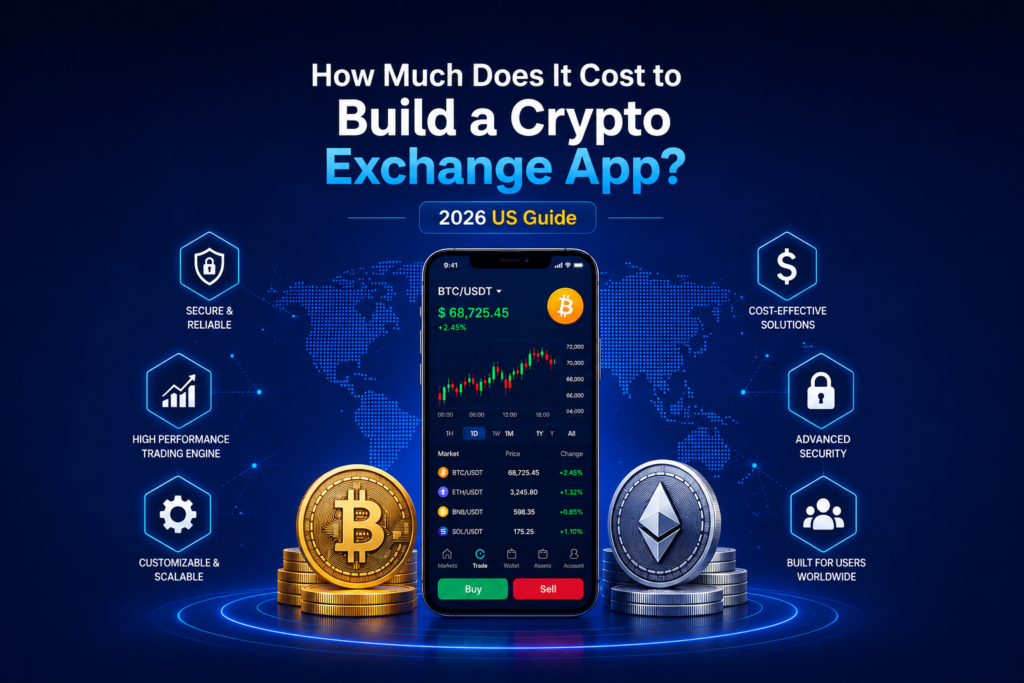
Building a crypto exchange app in the United States typically costs $40,000 to $100,000 for a lean MVP and $250,000 to $500,000+ for a full-scale, compliant platform. The final number depends on your exchange model, feature depth, security and custody requirements, and the regulatory obligations that come with handling US users’ funds. These are planning estimates, not quotes your real figure comes from scope.
That range is wide for a reason. A crypto exchange app isn’t one product; it’s a stack of hard problems a trading engine, a wallet and custody layer, identity verification, real-time data, and a compliance posture sitting under a clean interface. Two apps that look identical on the surface can differ by six figures underneath.
This guide breaks down what actually drives crypto exchange app development cost for a US business, what you’re legally on the hook for when you operate in this market, and how to plan a budget that survives contact with reality. It’s written for founders and product teams in Houston, across Texas, and throughout the US who are weighing whether and how to build.
Here’s a quick US cost snapshot (estimates, custom development):
| Build tier | What it includes | Estimated cost (USD) | Typical timeline |
| MVP / Prototype | Core spot trading, basic KYC, one fiat rail, single platform | $40,000 – $100,000 | 3 – 5 months |
| Standard exchange | Multi-asset trading, full KYC/AML, admin dashboard, mobile + web | $100,000 – $250,000 | 5 – 9 months |
| Full-scale platform | Deep liquidity integration, hardened custody, compliance-ready architecture | $250,000 – $500,000 | 9 – 14 months |
| Enterprise / advanced | Derivatives, margin, staking, advanced fraud tooling, multi-region | $500,000+ | 12 – 18 months+ |
Ranges assume custom development at US or US-managed blended rates and exclude licensing fees, legal counsel, and ongoing operational costs, which are covered separately below. You can also run your own quick estimate with our cost calculator
Get a free project consultation. Share your feature list and target market with Go Tech Solutions and get a scoped, written estimate instead of a guess.
What Is a Crypto Exchange App?
A crypto exchange app is a software platform that lets users buy, sell, and trade cryptocurrencies and often convert between crypto and traditional currency (fiat). Behind the interface, it coordinates order matching, wallet and custody management, identity verification, and settlement, usually across both a mobile app and a web dashboard.
The important distinction for anyone planning a build: an exchange is a financial software system, not a simple marketplace. It holds value, moves value, and depending on the model takes custody of other people’s assets. That single fact is what pushes it into a higher cost, security, and compliance tier than most consumer apps.
How Does a Crypto Exchange App Work?
At a high level, a user’s journey through the app touches every expensive part of the system:
- Sign up and verify: the user registers and completes identity verification (KYC), screened against watchlists (AML).
- Fund the account: they deposit fiat through a bank or card rail, or deposit crypto into a wallet the platform generates for them.
- See the market: live prices, order books, and charts stream in from market-data feeds.
- Place an order: the request hits the matching engine, which pairs buyers and sellers and executes the trade.
- Settle and record: balances update, funds move between hot and cold wallets, and the transaction is written to an immutable ledger.
- Withdraw: the user cashes out to a bank account or sends crypto to an external wallet, subject to security checks.
Every one of those steps is a component you pay to build, secure, and maintain. The matching engine and the wallet/custody layer carry the most engineering hours and the most risk.
How Much Does It Cost to Build a Crypto Exchange App in the US?
The headline range again: roughly $40,000 for a lean MVP up to $500,000+ for a full, compliant platform. Where you land is a function of five things the exchange model, how many features you ship at launch, your security and custody model, which integrations you need, and how heavy your US compliance obligations are.
US-built or US-managed development sits at a higher hourly rate than fully offshore work, which is why identical feature lists can cost meaningfully more here than in lower-cost regions. What you’re paying for is closer oversight, same-timezone communication, and accountability on a system where mistakes are expensive. Many US businesses split the difference with a US-based partner that manages a global engineering team the model Go Tech Solutions uses from its Houston base.
Total development cost ≈ development hours × blended team rate. Hours are driven by scope and complexity; the rate is driven by team seniority and location.
If you’re comparing categories, our guide to app development cost shows how the same drivers play out in a different type of build.
Types of Crypto Exchange Apps and How They Affect Cost
The model you choose changes your architecture, your custody responsibilities, and your budget more than almost any other decision.
Centralized Exchange (CEX)
The operator controls the order book, executes trades, and holds user funds. It’s the most familiar model and the most feature-rich but taking custody of assets raises security stakes and, in the US, triggers the heaviest regulatory obligations. Highest cost and compliance load.
Decentralized Exchange (DEX)
Trades settle through smart contracts and users keep custody of their own assets. You avoid some custodial obligations, but you take on specialized smart-contract engineering and mandatory security audits, which are expensive in their own right. Comparable cost to a CEX, different risk profile.
Hybrid Exchange
Combines centralized speed with an optional self-custody path. Flexible, but you’re effectively building and maintaining two models, so complexity and cost rise. Higher build effort.
Peer-to-Peer (P2P)
Connects buyers and sellers directly with an escrow layer holding funds until both sides confirm. Structurally simpler, so often the most affordable to build, though you still need strong identity checks and dispute handling.
White-Label
A pre-built platform you rebrand and configure. Fastest and cheapest to launch, but you inherit the vendor’s roadmap, limits, and licensing constraints and you don’t own the core IP. Useful for validating demand before committing to a full custom crypto exchange development project.
Here’s how the models compare at a glance:
| Model | Who holds funds | Relative build cost | Best when |
| Centralized (CEX) | The operator (custodial) | High | A familiar, feature-rich product; you can meet heavier US compliance. |
| Decentralized (DEX) | Users (non-custodial) | High (smart-contract audits) | You want to avoid holding funds and can invest in on-chain engineering. |
| Hybrid | Optional self-custody | Highest | Centralized speed with a self-custody path (two models in one). |
| Peer-to-peer (P2P) | Escrow holds temporarily | Lower | A simpler structure with strong identity checks and disputes. |
| White-label | Depends on vendor | Lowest / fastest | Validate demand fast and accept the vendor’s limits. |
What Factors Affect Crypto Exchange App Development Cost?
Features
Every feature is build hours plus test hours plus maintenance. A trading engine, margin, staking, and fiat on/off ramps each add materially to the total; a lean spot-trading MVP is a fraction of a multi-product platform.
UI/UX Design
Financial interfaces have to make complex data legible and trustworthy under real conditions. Thoughtful UI/UX design costs more upfront but reduces failed trades, support tickets, and churn a real return, not a line item to trim.
Backend & Trading Engine
The order-matching engine and settlement logic are the technical heart of the product. They carry the most engineering hours and are where scope creep most often hides. This is not the place to cut corners.
Security
Multi-signature wallets, cold-storage segregation, encryption, two-factor authentication, and independent penetration testing are non-negotiable when you hold or move value. Cold-storage segregation and multi-sig approvals limit how much can be lost if any single credential or hot wallet is compromised.
Integrations
KYC/AML providers, price-feed APIs, payment and banking rails, and liquidity providers each add setup cost and ongoing fees. Banking and fiat integrations are often the slowest and most unpredictable part of a US build.
Cloud Infrastructure
An exchange has to stay up 24/7 with room to scale during volume spikes. Auto-scaling cloud architecture (AWS, Azure, or GCP) plus DevOps is a real build-and-run cost, not an afterthought.
US Compliance
The single biggest factor US planners underestimate covered in its own section below because it shapes architecture, not just paperwork.
Development Team
Team seniority and location move both price and outcome. A cheaper, less experienced team can cost more in the end through rework, delays, and security gaps. An experienced team that gets custody and compliance right the first time is usually the better economics.
Core Features of a Crypto Exchange App
- User onboarding & KYC/AML — identity verification and screening built into signup.
- Wallet & custody — hot wallets for liquidity, cold storage for the bulk of funds.
- Order-matching / trading engine — the core buy/sell execution logic.
- Multi-asset support — the coins and tokens you list.
- Fiat on/off ramp — deposit and withdraw traditional currency via bank or card.
- Admin dashboard — operations, user management, monitoring, and reporting, often paired with business process automation to reduce manual work.
- Security layer — 2FA, multi-sig, encryption, anomaly detection.
- Real-time market data & charts — live pricing and portfolio views.
- Notifications — trade confirmations, price alerts, security events.
- Analytics — user, transaction, and revenue insight.
The Admin Panel: The Half of the Product Users Never See
It’s easy to budget the user-facing app and forget that a crypto exchange is also an operations platform. The admin side is frequently a third or more of total development effort, and skipping it isn’t an option: without it you can’t run the business or satisfy regulators. A capable admin panel typically includes:
- User management and account status controls.
- KYC review and approval queues for flagged verifications.
- Transaction monitoring and suspicious-activity flags.
- Wallet and asset management (listings, hot/cold balances, withdrawals).
- Trading and fee controls (pairs, limits, fee schedules).
- Reporting and analytics for finance, compliance, and growth.
- Security monitoring and audit logs (who did what, when).
- Support tooling to resolve tickets and disputes.
Much of this benefits from business process automation so your team isn’t doing high-stakes work by hand.
Wallets, Custody, and Integrations
Your custody model is the fork in the road. In a custodial model you hold users’ private keys and their funds, which maximizes convenience but makes you responsible for securing (and, in the US, often for being licensed to hold) other people’s money. In a non-custodial model users hold their own keys, which reduces your custody burden but shifts complexity onto wallet UX and on-chain logic.
On top of custody, an exchange is only as capable as the services it connects to. The integrations that most affect cost and timeline:
- Blockchain networks and node infrastructure (which chains you support).
- Wallet infrastructure (hot wallet, cold storage, multi-signature approvals).
- Payment and banking rails for fiat on/off ramps (often the slowest, least predictable line item in a US build).
- Liquidity providers so a new exchange is actually usable at launch.
- Market-data / price-feed APIs for accurate real-time pricing.
- KYC / identity providers for compliant onboarding.
Each integration adds setup cost and, usually, ongoing per-use fees. Scope them early: they move the budget more than most feature decisions.
Crypto Exchange App Technology Stack
A representative, production-grade crypto exchange app development stack:
| Layer | Common choices | Why it matters |
| Mobile frontend | React Native or Flutter | One codebase for iOS + Android cuts frontend cost |
| Web frontend | React / Next.js | Trading dashboards and admin tooling |
| Backend | Node.js, Go, or Java | Handles matching, settlement, and APIs |
| Blockchain layer | Ethereum, Polygon, Solidity (on-chain/DEX) | Smart contracts and on-chain settlement |
| Database | PostgreSQL + Redis | Transactional integrity + fast caching |
| Cloud / DevOps | AWS, Azure, or GCP | 24/7 uptime and auto-scaling |
| KYC tooling | Established verification providers | Compliant onboarding |
| Market data | Reputable price-feed APIs | Accurate real-time pricing |
The mobile app development side benefits most from cross-platform frameworks, while the trading dashboard is a web application development effort in its own right. Cross-platform frameworks and managed cloud/node providers are two of the most reliable ways to control cost without compromising quality.
How Long Does It Take to Build a Crypto Exchange App?
A focused MVP generally takes 3–5 months; a full compliant platform runs 9–14 months, with US licensing work often running in parallel rather than after the build.
| Phase | Key work | Typical duration |
| Discovery & planning | Market/feature scoping, compliance roadmap, wireframes | 3–6 weeks |
| UI/UX design | Screen design, prototyping, user testing | 4–6 weeks |
| Backend development | Trading engine, wallet infrastructure, APIs, database | 10–16 weeks |
| Frontend development | Mobile apps + web dashboard | 8–12 weeks |
| Security & compliance | Pen testing, audits, KYC/AML integration | 4–8 weeks |
| QA & testing | Load, security, and user-acceptance testing | 3–5 weeks |
| Deployment & launch | App-store submission, infrastructure, go-live checks | 2–4 weeks |
The backend phase carries the most hours and the most risk plan cash flow and milestones around it.
The Crypto Exchange App Development Process
- Discovery — define the model, target users, feature set, and compliance path before a line of code. A short technical consultancy engagement is often the cheapest way to de-risk this stage.
- Design — UX research and interface design that make a complex product feel safe and clear.
- Architecture — custody model, security posture, and scalability decided upfront.
- Development — backend, frontend, and integrations built in tested increments.
- QA — parallel testing throughout, not bolted on at the end.
- Launch — staged deployment with monitoring in place.
- Post-launch support — maintenance, updates, and scaling as usage grows.
A team that runs QA in parallel and stays involved after launch the way Go Tech Solutions structures delivery reduces the expensive surprises that show up right after go-live.
Get a free project consultation. Not sure which features belong in your MVP versus phase two? We can help you scope a build that fits your budget and timeline.
US Regulatory & Compliance Considerations
This is where a US build diverges most from guides written for other markets, and it’s the biggest planning gap most founders hit. None of the following is legal advice engage qualified US counsel early but you should budget and architect for it from day one.
- FinCEN registration. Many US crypto businesses that exchange or transmit value are treated as Money Services Businesses and register with FinCEN, which brings Bank Secrecy Act obligations.
- State money-transmitter licensing. Depending on your model and states served, you may need money-transmitter licenses state by state a significant time and cost commitment. Requirements differ across states, including Texas.
- BSA/AML program. Written AML policies, transaction monitoring, suspicious-activity reporting, and a designated compliance function.
- KYC obligations. Identity verification and screening built into onboarding.
- Securities/commodities uncertainty. Whether specific assets or products fall under SEC or CFTC oversight is fact-specific and evolving.
The practical takeaway: your custody model and compliance obligations dictate your architecture, so they belong in the discovery phase, not after launch. Building for compliance from the start is far cheaper than retrofitting it.
Build vs Buy: Custom, White-Label, or Hybrid?
| Approach | Control & IP | Time to launch | Cost profile | Trade-off |
| Build from scratch (custom) | Full ownership | Longest | Highest upfront, best long-term economics | Maximum flexibility; you own everything. |
| White-label | Vendor owns core | Fastest | Lowest upfront, ongoing licensing | Quick to market, limited by the vendor’s roadmap. |
| Hybrid (custom on infrastructure) | Shared | Medium | Medium | Buy commodity pieces (KYC, custody, liquidity), build your differentiators. |
For most US businesses the hybrid path is the pragmatic middle: use proven third-party infrastructure for the commodity layers and invest custom engineering where you actually differentiate. White-label is a smart way to validate demand before committing to full custom development.
MVP vs Full-Scale Exchange: Which Should You Build First?
For most US businesses, an MVP first is the stronger play. Ship a focused product spot trading, solid KYC, one fiat rail, tight security get it in front of real users, and let actual behavior guide the roadmap. You reach the market faster, spend less before validation, and avoid over-building features nobody uses.
A full-scale build makes sense when you already have committed users, capital, and a compliance path and need derivatives, margin, staking, and multi-region support from day one. Those larger builds usually land in enterprise applications territory, with role-based access, automation, and heavy reporting. An MVP scope keeps upfront cost lower and produces the real usage data that de-risks the bigger investment.
Hidden Costs to Plan For
- Security audits & penetration testing — recurring, not one-time.
- Liquidity — a new exchange needs liquidity to be usable, often via a provider with ongoing fees.
- Compliance & legal counsel — licensing, filings, and a compliance function.
- KYC verification fees — usually per-user, so they scale with growth.
- Third-party API and data fees — price feeds, banking rails, and more.
- Banking/payment integration — often the slowest, least predictable line item.
- Infrastructure at scale — cloud costs rise with usage.
Ongoing Costs After Launch (Total Cost of Ownership)
Development is the down payment. Running the platform is the mortgage. Budget for cloud hosting, security monitoring and periodic audits, KYC verification fees, liquidity, compliance upkeep, customer support, and continuous maintenance and feature work. A realistic first-year total cost of ownership can meaningfully exceed the initial build cost model it before you launch, not after.
How to Reduce Crypto Exchange App Development Cost
- Use cross-platform development (React Native / Flutter) to cover iOS and Android from one codebase.
- Launch a lean MVP and add margin, staking, and advanced tooling once you have users and data.
- Use managed cloud and node providers instead of self-hosting complex infrastructure.
- Validate with white-label or a prototype before committing to full custom development.
- Work with a US-managed team that blends senior oversight with global engineering — you can even hire a dedicated team or add senior developers to control rate without losing accountability.
Where AI Lowers the Cost
AI has changed the economics of building software, and a crypto exchange app is no exception. When a development team pairs AI tools with experienced engineers, much of the routine work moves faster boilerplate code, test coverage, documentation, code review, and early interface drafts can all be sped up. Fewer hours go into repetitive tasks, and more of the budget goes toward the parts that genuinely need human judgment.
The result is usually a modest reduction in both cost and timeline. It isn’t a magic discount, and it doesn’t replace the team: AI handles the first draft, while senior engineers still design the architecture, secure the wallet and custody layer, and make the compliance decisions a model can’t be trusted with on its own. For a product that holds user funds, that human oversight isn’t optional.
The right balance is AI and human effort working together AI to remove the grind, people to own the decisions that carry real risk. Handled that way, you get a build that’s a little leaner and a little faster without cutting the corners that matter. We covered that balance in more depth in custom vs AI-first development.
Where not to cut: security, custody, and audits. Saving money on the parts that protect user funds isn’t a saving it’s an unpriced risk that can end the business.
How to Choose a Crypto Exchange App Development Company
Look for demonstrable engineering depth in complex, data-heavy, and financial-grade systems; a clear security and QA process; transparent, milestone-based billing; explicit IP ownership terms; and communication that fits your timezone. For US businesses, a partner who understands US delivery expectations written timelines, same-day responsiveness, real post-launch support reduces both risk and total cost. Ask to see relevant case studies, like this complex SaaS platform or this admin ecosystem build, and how they handle testing and maintenance not just the initial build.
Building With a Houston-Based Software Development Team
Houston has grown into a serious technology hub, and Texas businesses increasingly want a development partner that combines local accountability with the cost efficiency of a global engineering team. That’s the model Go Tech Solutions works in: a custom software development company headquartered in Houston, Texas, with US-based project management, a senior engineering team, milestone-based billing, parallel QA, and post-launch support. You can read more about our team and browse the full portfolio of shipped work.
To be clear about roles: Go Tech Solutions builds custom digital products mobile apps, web applications, custom software, backend systems, API integrations, and cloud infrastructure. If you’re planning a crypto exchange app or any complex fintech-adjacent platform, Go Tech Solutions is the team that designs and engineers it. It does not operate an exchange, hold customer funds, or provide trading or investment services you own and operate the product; we build it to your spec.
Get a free project consultation. Tell us what you’re trying to build. You’ll get an honest, written estimate and a clear scope — no pressure, no jargon.
Frequently Asked Questions
How much does it cost to build a crypto exchange app?
In the US, roughly $40,000–$100,000 for a lean MVP and $250,000–$500,000+ for a full, compliant platform. The exact figure depends on your exchange model, features, security requirements, and compliance obligations.
How much does crypto exchange app development cost in the USA?
US or US-managed development sits at higher rates than fully offshore work, so US builds typically run higher than the same scope elsewhere. A well-scoped MVP still starts in the tens of thousands, with full platforms reaching the mid-six figures.
How long does it take to develop a crypto exchange app?
A focused MVP takes about 3–5 months; a full platform takes 9–14 months, often with compliance work running in parallel.
What features does a crypto exchange app need?
At minimum: secure onboarding with KYC/AML, wallet and custody management, a trading/order-matching engine, a fiat on/off ramp, an admin dashboard, real-time market data, and a strong security layer.
What technology is used to build a crypto exchange?
Commonly React Native or Flutter (mobile), React/Next.js (web), Node.js/Go/Java (backend), PostgreSQL and Redis (data), cloud infrastructure on AWS/Azure/GCP, and for on-chain features Ethereum/Polygon with Solidity.
Can I build a crypto exchange app for my business?
Yes. Most businesses start with an MVP to validate demand, then expand. A capable custom software partner can scope, build, and support it while you own and operate the product and handle licensing with qualified counsel.
What affects cryptocurrency app development cost the most?
Scope and custody complexity, security requirements, third-party integrations, and US compliance obligations in roughly that order.
What budget and timeline should I expect for an MVP?
Plan for roughly $40,000–$100,000 and 3–5 months for a focused MVP (spot trading, KYC, one fiat rail, strong security), with compliance work often running in parallel.
What security measures does a crypto exchange need?
Encryption, 2FA, multi-signature wallets, cold-storage segregation, role-based access controls, API security, transaction monitoring, audit logging, and recurring penetration testing. No system is ever fully “hack-proof”; the aim is layered defense.
Conclusion
A crypto exchange app is one of the more demanding products a business can commission part trading system, part security fortress, part compliance program. That’s exactly why a clear budget, a sensible MVP-first strategy, and an experienced development partner matter so much. Get the scope and the custody model right early, plan for compliance and total cost of ownership from day one, and the rest becomes a manageable engineering problem.
If you’re a business in Houston, Texas, or anywhere in the US weighing a build, Go Tech Solutions can help you turn a rough idea into a scoped, costed, and buildable plan and then engineer it.