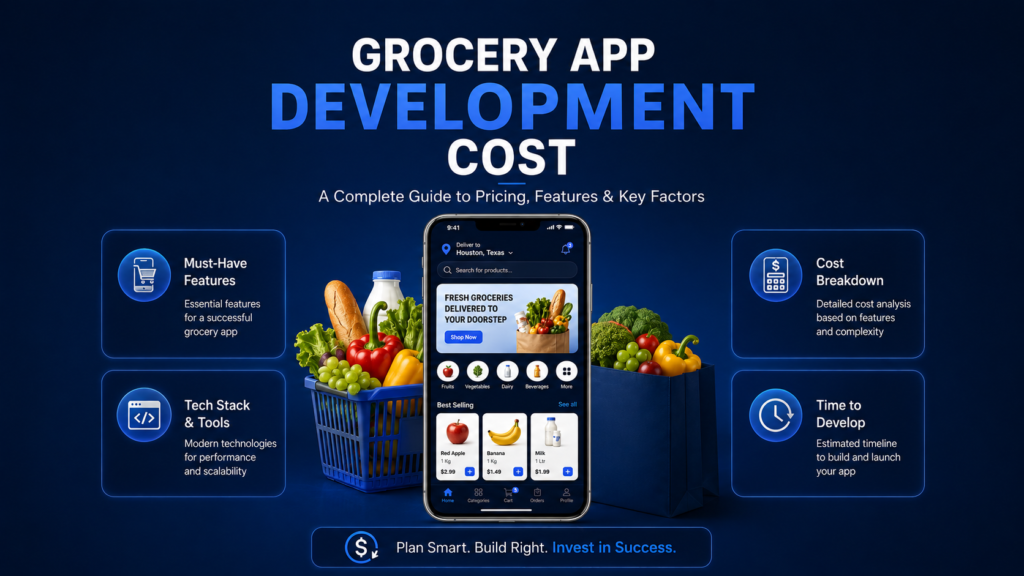
Grocery app development typically costs $35,000 to $600,000+ in the U.S. in 2026 and where you land inside that range is decided by four things: your business model, how many user roles (customer, driver, admin, vendor) you support, how real-time your inventory has to be, and which U.S. compliance rules apply. Screen count barely moves the number; those four levers move it a lot.
A grocery app looks simple from the outside browse, add to cart, pay, wait for delivery. Underneath sit real-time inventory, payments, order routing, driver dispatch, live tracking, item substitutions, and separate apps for customers, drivers, stores, and admins. That hidden complexity is why quoted prices swing so widely. This guide gives honest U.S. ranges for 2026, what could move them in 2027, and the parts most cost articles skip: U.S. payment and compliance realities (including SNAP/EBT online), a real Houston/Texas view, architecture, what’s actually inside your cost, and a clean split between build, operating, and marketing budgets. Every number here is a transparent range your real figure depends on scope.
Grocery App Development Cost: Quick Answer
Grocery app development typically costs $35,000 to $600,000+ in the United States in 2026. A lean single-store MVP (customer app + admin) usually lands around $35,000–$70,000, a multi-store delivery app with a driver app and live tracking around $70,000–$180,000, and a multi-vendor marketplace or quick-commerce platform $180,000–$600,000+. The range is that wide because business model, number of user roles (panels), real-time inventory sync, and compliance requirements move the price far more than screen count. Want a scoped number instead of a range? Our cost calculator gives a starting estimate in minutes.
Grocery App Development Cost by App Type
The fastest way to place your project is by “level.” Costs and timelines below are typical U.S.-market estimates and should be validated against a real feature list.
| App type | Cost estimate (USD) | Timeline | Complexity | Core features | Best suited for |
| Basic MVP (single store) | $35,000–$70,000 | 3–5 months | Low | Catalog, cart, checkout, scheduled slots, admin panel | Local grocer testing demand |
| Mid-level grocery app | $70,000–$140,000 | 5–7 months | Medium | Multi-store catalog, driver app, live tracking, payments | Regional chains, funded startups |
| Advanced delivery platform | $140,000–$260,000 | 7–10 months | High | Real-time dispatch, POS sync, promotions, analytics | Scaling delivery brands |
| Multi-vendor marketplace | $180,000–$350,000 | 8–12 months | High | Vendor portal, commissions, payouts, dispute handling | Instacart-style aggregators |
| Enterprise grocery platform | $300,000–$600,000+ | 12–18+ months | Very high | Dark stores, quick commerce, demand forecasting, multi-region | Enterprise retail, q-commerce |
A pattern we see constantly: businesses assume they’re in the marketplace tier and are usually better served launching a single-store version first. Real order data is cheaper to buy with an MVP than with dispatch logic you may not need yet.
Get a real number, not a range. Send us your feature list and we’ll map it to a scoped estimate and a realistic timeline before you commit budget.
What Is Grocery App Development?
Grocery app development is the process of designing, engineering, testing, and launching the software that lets shoppers browse groceries, pay, and receive them by pickup or delivery plus the back-office systems that keep inventory, orders, and drivers in sync. It usually spans several connected applications rather than one app. Go Tech Solutions approaches it as custom software development, not a template install, because grocery operations rarely fit an off-the-shelf mold.
The category contains several distinct entities that are often confused:
- A grocery app is the umbrella term for any app used to shop for groceries.
- A grocery ordering app / grocery shopping app focuses on browsing a catalog and placing an order, sometimes for in-store pickup only.
- A grocery delivery app adds fulfillment: driver assignment, routing, and real-time tracking to the customer’s door.
- A grocery marketplace (multi-vendor) app connects many stores or vendors to shoppers, adding vendor onboarding, commissions, and payouts.
- A grocery aggregator app lists third-party stores and passes orders to them, often without holding inventory.
In short: every grocery delivery app is a grocery app, but not every grocery app handles delivery and marketplaces add an entire vendor layer on top.
What Are the Types of Grocery App Development?
The type you choose sets the cost floor before a single feature is added.
- Single-store grocery app — one owner, one catalog. Cheapest to build and operate; no vendor logic. Lowest cost.
- Grocery delivery app — adds a driver app, dispatch, and live tracking. Low–medium cost.
- Multi-vendor grocery marketplace — vendor portal, per-vendor pricing, commissions, payouts. High cost; ~30–40% of budget is back-office the shopper never sees.
- Grocery aggregator app — routes orders to partner stores; light on inventory, heavy on integrations. Medium–high cost.
- Inventory-based grocery app — you own the stock and control one source of truth. Medium build, heavy operations.
- Hybrid grocery platform — partial owned inventory plus partner supply. High cost; adds slot and routing logic.
- Quick-commerce grocery app — dark stores and sub-30-minute delivery with order batching. Very high cost.
- Enterprise grocery ecosystem — multi-region, forecasting, ERP/POS integration, advanced analytics. Highest cost.
How Much Does It Cost to Build a Grocery Delivery App in the USA?
A grocery delivery app built for the U.S. market typically costs $70,000–$350,000+ depending on tier, and U.S.-specific requirements are a real part of that number not an afterthought. Three factors make U.S. builds distinct:
1. U.S. developer economics. Fully in-house U.S. teams are the most expensive path: the U.S. Bureau of Labor Statistics reports a median annual wage of $133,080 for software developers (May 2024), and the broader computer-and-IT group’s median was $105,990 (BLS). Blended models (U.S.-based management with global engineering) exist specifically to keep quality high while controlling that cost.
2. SNAP/EBT online the U.S. grocery differentiator. Millions of Americans pay for groceries with SNAP benefits, and online SNAP purchasing is now available nationwide (USDA). If you want that customer base, your app must meet USDA requirements: you work with an approved third-party processor currently Fiserv, WorldPay, or Forage and an approved eCommerce platform, remove guest checkout, add EBT-specific velocity controls (limited balance inquiries and card changes), separate SNAP-eligible from ineligible items, and never charge SNAP benefits for delivery, service, or convenience fees (USDA retailer requirements). This is a scoped engineering workstream most generic guides ignore.
3. Payment security, accessibility, and tax. Card handling must follow PCI DSS (PCI SSC); consumer-facing apps should be built to WCAG/ADA accessibility expectations (W3C WAI, ADA.gov); and grocery sales tax varies by state and even by item category, so tax logic is real work, not a toggle.
How Much Does It Cost to Build an App Like Instacart (or a Major Chain)?
An Instacart-style multi-vendor build typically costs $180,000–$350,000+, because it needs a vendor portal, commissions, payouts, dispatch, and real-time inventory across many stores. A single-chain build (one retailer’s own branded app) is usually cheaper than a marketplace because there’s one catalog and no vendor settlement, landing closer to the delivery-app tier. The cost driver in either case is the same: how many parties transact through the app, and how live your inventory must be. If you’re benchmarking against a specific app, send us its core flows and we’ll map them to a tier — the name matters less than the architecture behind it.
What Will Actually Be in Your Cost and Your Customers’ Total?
Your build total is the sum of the phase and feature tables below design, backend, the frontends you need (customer, and later driver/vendor/admin), integrations (payments, maps, and SNAP/EBT if relevant), QA, and launch plus ongoing operating and marketing budgets kept in separate columns (see Development vs. Operational vs. Marketing Costs). You can predict it before building by scoping the feature list and number of panels first; everything else follows from those.
Your customers’ order total is a different thing shoppers ask about, and it affects the checkout logic you have to build. A grocery order total is typically item subtotal + delivery fee + service fee + optional tip + tax, sometimes with per-item markup on marketplace models. If transparent pricing matters to your brand, that’s a design and engineering decision itemised fee breakdowns, “estimated total” previews, and substitution price-adjustment logic all live in the checkout and need budgeting. Building that clarity in early is cheaper than retrofitting it after launch.
How Much Does Grocery App Development Cost in Houston, Texas?
Grocery app development cost in Houston follows the same U.S. tiers above roughly $35,000 for an MVP to $600,000+ for an enterprise platform because price is driven by scope, not zip code. There is no separate “Houston price list.” What a Houston base does change is how the project is run and where your money goes.
Cost in Houston varies with the same levers as anywhere in the U.S.: team composition (in-house vs. blended), technology choices (cross-platform vs. native), feature depth, architecture (monolith vs. microservices), UI/UX ambition, third-party integrations (POS, payments, maps), and backend complexity (real-time inventory and dispatch). The practical Houston advantage is proximity: same-timezone communication, faster decision loops, and a partner who understands the Texas retail and last-mile landscape. Go Tech Solutions is headquartered in Houston and runs U.S.-based project management while keeping engineering cost-effective the same model we describe in our Houston app-cost guides.
Planning a grocery build in Houston or across the U.S.? Talk to a Houston-based team that has shipped multi-vendor, inventory, and marketplace platforms.
Grocery App Development Cost by Business Model
Your business model sets the floor. Estimated U.S. ranges:
- Inventory model — $40,000–$120,000. You own the stock, so there’s one catalog and no vendor settlement. Cheapest to build, heaviest to operate.
- Aggregator model — $90,000–$180,000. You list partner stores and pass orders along; cost sits in integrations and order routing.
- Marketplace model — $180,000–$350,000. Vendor portal, per-vendor pricing, commissions, and payouts push a large share of budget into back-office logic. This is the eCommerce/marketplace tier.
- Hybrid model — $200,000–$450,000. Owned dark-store inventory plus partner supply; adds slot management and demand forecasting.
- Quick commerce — $300,000–$600,000+. Dark stores, rider batching, and sub-30-minute promises add the most operational software.
Grocery App Development Cost by Features
Feature scope is where budgets quietly grow. The estimates below are per-feature U.S. build costs; totals depend on how they interact.
| Feature | Typical cost impact (USD) | Notes |
| User registration & profiles | $1,500–$5,000 | Social/OTP login adds cost |
| Product catalog & categories | $4,000–$12,000 | Scales with SKU count |
| Search & filters | $3,000–$9,000 | Relevance/autocomplete raises it |
| Shopping cart & checkout | $4,000–$10,000 | Substitutions add complexity |
| Payment gateway | $3,000–$9,000 | Stripe/PayPal; PCI scope matters |
| SNAP/EBT online | $8,000–$30,000+ | Approved processor + USDA rules |
| Order tracking & GPS | $4,000–$12,000 | Real-time = higher |
| Push notifications | $1,500–$4,000 | Order + marketing streams |
| Delivery scheduling / slots | $3,000–$9,000 | Capacity logic |
| Coupons & loyalty programs | $5,000–$15,000 | Point tracking at checkout |
| Reviews & ratings | $2,000–$6,000 | Moderation adds cost |
| AI recommendations | $8,000–$25,000 | Needs behavioral data |
| Inventory management & POS sync | $15,000–$60,000 | The most underestimated line |
| Vendor management portal | $18,000–$45,000 | Marketplace-only |
| Admin dashboard | $12,000–$35,000 | Refunds, disputes, promos live here |
| Analytics & reporting | $6,000–$20,000 | Ops + retail-media data |
| Route optimization | $10,000–$30,000 | Quick-commerce essential |
Real-time inventory synchronization is the single line most first-time budgets underestimate handling stock conflicts, price changes, and out-of-stock substitutions across stores is genuine engineering, not configuration. Our inventory management work exists largely because of this.
Grocery App Development Cost Breakdown by Development Phase
| Phase | Est. cost (USD) | Typical duration | Key activities |
| Discovery & business analysis | $3,000–$15,000 | 1–3 weeks | Scope, user roles, success metrics |
| UI/UX design | $5,000–$20,000 | 3–6 weeks | Wireframes, prototypes, design system |
| Frontend development | $10,000–$50,000 | 6–10 weeks | Customer/driver/vendor screens |
| Backend & API development | $15,000–$70,000 | 8–12 weeks | Server, DB, order & inventory logic |
| Payment + SNAP/EBT integration | $6,000–$35,000 | 2–5 weeks | Gateways, EBT processor, tax |
| Maps / GPS / dispatch | $6,000–$25,000 | 2–5 weeks | Tracking, routing |
| QA & testing | $6,000–$20,000 | 4–6 weeks | Functional, regression, performance |
| Security & compliance | $4,000–$18,000 | Ongoing | PCI, data protection, accessibility |
| Deployment & launch | $2,000–$8,000 | 1–2 weeks | App Store/Play, cloud setup |
| Maintenance (annual) | 15–25% of build | Ongoing | Patches, updates, scaling |
Design and QA run in parallel with development at Go Tech Solutions QA isn’t bolted on at the end which is why our UI/UX design and testing phases overlap the build.
Have a budget but no scope? We’ll turn your idea into a phased, costed build plan — the cheap wins separated from the expensive must-haves.
Grocery App Development Timeline
| Build | Typical timeline | Milestones |
| MVP (single store) | 3–5 months | Discovery → design → build → launch |
| Mid-level delivery app | 5–7 months | + driver app, live tracking |
| Advanced platform | 7–10 months | + dispatch, POS sync, analytics |
| Marketplace | 8–12 months | + vendor portal, payouts |
| Enterprise / quick commerce | 12–18+ months | + dark stores, forecasting, multi-region |
Grocery App Features You Need in 2026 and 2027
Essential features
Catalog and search, cart and secure checkout, multiple payment methods (and SNAP/EBT if you serve that market), delivery scheduling, real-time order tracking, push notifications, a driver app, and an admin dashboard. These are table stakes for a usable grocery experience.
Advanced features (2026–2027 momentum)
AI-powered product recommendations and personalized shopping, intelligent inventory forecasting, route optimization for last-mile efficiency, automated customer support (chat/agents), retail-media and in-app advertising infrastructure, subscription memberships, and scalable cloud analytics. These are best phased in after launch, when you have behavioral data to feed them. Advertising in particular has become a genuine margin stream for large grocery platforms, so budgeting an ad layer early is increasingly rational but only once your core ordering flow is stable.
A note on 2027: we don’t make hard predictions. What’s reasonable to expect is that AI-assisted development tooling and more mature managed cloud/AI services may improve delivery efficiency, while demand for U.S. engineering talent (BLS projects 15% growth for software developers, 2024–2034) keeps skilled-labor rates firm. Plan 2027 budgets as ranges, not fixed figures.
How Grocery Delivery Apps Work
A grocery delivery platform is a multi-sided system. The order flows like this:
Customer app → Backend/APIs → Store or vendor system → Admin dashboard → Delivery partner app → Customer.
- The shopper browses the catalog and places an order in the customer app.
- The backend validates inventory, processes payment, applies tax, and creates the order.
- The store/vendor receives and picks the order (with substitution handling for out-of-stock items).
- The admin dashboard oversees orders, refunds, disputes, promotions, and reporting.
- The delivery partner app receives the assignment, navigates an optimized route, and confirms handoff.
- The customer tracks everything in real time until delivery.
Marketplaces add a vendor portal so each store manages its own inventory, pricing, and payouts. The dispatch and last-mile layer mirrors what we build for courier and delivery services and logistics/warehousing.
Grocery App Technology Stack
Technology is chosen to fit the workload, not to pad a keyword list. Common, defensible choices:
| Layer | Common choices | Why |
| Mobile (cross-platform) | React Native, Flutter | ~20–40% cheaper than dual native; fine for most grocery use cases |
| Mobile (native) | Swift, Kotlin | Best performance for heavy catalogs |
| Frontend (web/admin) | React, Next.js | Fast admin and vendor portals |
| Backend | Node.js, Python, .NET | Node.js suits real-time order flows |
| Database | PostgreSQL, MongoDB | PostgreSQL for transactions, MongoDB for catalogs |
| Cloud | AWS, Azure, GCP | Scales with order volume |
| Real-time | WebSockets, Firebase | Live tracking and updates |
| Payments | Stripe/PayPal + approved EBT processor | PCI-compliant checkout |
Go Tech Solutions builds across these stacks for mobile app development and web application development; the architecture decision (monolith vs. microservices) usually matters more to cost than the language.
Factors That Affect Grocery App Development Cost
- Platform (single vs. dual; cross-platform vs. native)
- App complexity & number of user roles/panels (customer, driver, admin, vendor)
- Backend architecture (monolith is cheaper below a few thousand daily orders)
- Real-time inventory sync & POS/ERP integrations (the big budget mover)
- Third-party APIs (maps, SMS, payments, EBT)
- Real-time tracking & route optimization
- AI features (recommendations, forecasting)
- Cloud infrastructure & scalability
- Security & U.S. compliance (PCI DSS, SNAP/EBT rules, ADA/WCAG)
- Design depth (template vs. fully branded)
- Development team model & location
- Maintenance (15–25% of build annually)
Grocery App Development Cost: In-House vs. Outsourcing
There’s no universally “cheapest” option only the right fit for your stage and risk tolerance.
| Model | Relative cost | Best for | Trade-off |
| U.S. in-house team | Highest | Long-term product ownership | High fixed cost; slow to hire (BLS median dev wage $133,080) |
| U.S. development company | High | Complex, compliance-heavy builds | Premium rate, lower coordination risk |
| Nearshore (Latin America) | Medium | Timezone overlap on a budget | Vet portfolio depth in grocery |
| Offshore | Lowest sticker rate | Cost-sensitive builds | Rework can erase savings; manage delivery risk |
| Blended (U.S. management + global engineering) | Medium | Most startups & mid-market | Requires a partner who runs it well |
The blended model is why Go Tech Solutions pairs U.S.-based project management with cost-effective engineering, and offers staff augmentation when you need to extend an existing team. The practical filter is always portfolio evidence in your category, not the hourly rate on paper.
How to Reduce Grocery App Development Cost
- Ship a genuine MVP, not a shrunken everything. Two panels (customer + admin) get you live; add driver and vendor panels when volume justifies them.
- Go cross-platform unless performance demands native one codebase, roughly 30% less build cost.
- Buy the plumbing. Payments, maps, SMS, and analytics are solved problems; custom-building them spends money users never notice.
- Phase features by revenue impact, not excitement. Loyalty and AI recommendations pay off more in month eight than month one.
- Reuse proven components and flows shoppers already understand.
- Right-size architecture. A monolith is perfectly fine below a few thousand daily orders. A quick technical consultancy review before you build prevents expensive rework.
How to Build a Grocery Delivery App (Step by Step)
- Choose your business model (inventory, aggregator, marketplace, hybrid, quick commerce).
- Define the MVP scope around a customer app + admin panel.
- Design the flows (wireframes → prototypes → design system).
- Build the backend and inventory sync, then the frontends.
- Integrate payments, maps, and — if relevant — SNAP/EBT via an approved processor.
- Test against real orders (functional, regression, performance).
- Launch on the App Store and Google Play, set up scalable cloud hosting.
- Add driver/vendor panels and advanced features once order volume justifies them.
For a closely related walkthrough, see our guide on how to build a food delivery app the multi-app architecture is nearly identical.
How Grocery Apps Make Money
- Vendor commissions (marketplace models) a percentage per order.
- Delivery fees — usually partial cost recovery, not full margin.
- Service fees — small percentage on the order.
- Subscriptions / premium memberships — drive retention more than revenue.
- In-app advertising & retail media — often the highest-margin stream at scale.
- Featured listings / promoted products — vendor-funded visibility.
Pick your revenue mix while you’re still scoping, because commissions, subscriptions, and ad infrastructure each require engineering you should budget up front.
Development vs. Operational vs. Marketing Costs
Keep these three budgets separate mixing them is how projects run out of money.
- Development cost (one-time build): design, engineering, QA, launch the tables above.
- Ongoing operational cost: maintenance (15–25% of build/year), cloud hosting (scales with order volume, not user count), third-party API fees, payment processing, and support tooling.
- Marketing / customer-acquisition cost: ads, ASO, promotions, and incentives. For consumer grocery apps this is frequently the largest first-year line sometimes exceeding the build itself so plan it deliberately, not as an afterthought.
Grocery App Development Challenges
- Real-time inventory synchronization and out-of-stock substitutions across stores.
- Last-mile delivery logistics and route efficiency.
- Payment reliability and PCI/EBT compliance.
- Scalability during peaks (weekends, holidays, promotions).
- Customer retention in a low-loyalty category.
- Vendor management and payout accuracy in marketplaces.
- Data security and fraud prevention.
None of these are reasons not to build they’re reasons to scope carefully and choose an engineering partner who has solved them before.
Grocery App Development in Houston and Across the USA
Go Tech Solutions is a software development company headquartered in Houston, Texas, serving startups, grocery businesses, retailers, and enterprises building ordering, delivery, and marketplace platforms across the United States. We combine U.S.-based project management with a 40+ person engineering, design, QA, and delivery team, and we’ve shipped the exact building blocks a grocery platform needs multi-vendor architecture, inventory control, and real-time dashboards as in our Godaam Technologies warehouse platform and LOQAL multi-vendor marketplace. Explore our grocery delivery capabilities to see how the pieces fit together.
Why Choose Go Tech Solutions for Grocery App Development?
We keep this to what’s verifiable:
- Houston-based, U.S.-run delivery. Same-timezone communication and same-day responsiveness, with a Houston, Texas headquarters.
- Engineers first. The company was founded by engineers; you talk to the people who build the software.
- Proven multi-vendor & inventory experience. Real platforms with vendor portals, inventory control, and real-time analytics (Godaam, LOQAL).
- Parallel QA and post-launch support. Testing runs throughout development, and support continues after go-live.
- Milestone-based billing. You pay against defined deliverables, not arbitrary schedules.
- Recognized on Clutch, GoodFirms, and DesignRush, with a client footprint across 7+ countries.
We scope in phases rather than handing over one number and hoping you’ll see which features are load-bearing for launch, which can wait, and what each phase costs.
Build your grocery delivery platform with a Houston team. Spend 30 minutes with our engineers and leave with a phased roadmap and a cost range you can defend to investors.
Frequently Asked Questions
How much does it cost to develop a grocery app? Most grocery apps cost $35,000–$600,000+ in the U.S. in 2026. A basic single-store MVP is $35,000–$70,000; a full delivery platform runs $140,000–$260,000; a multi-vendor marketplace or quick-commerce build can exceed $300,000. Your final figure depends on model, panels, and integrations.
How much does it cost to build a grocery delivery app in the USA? Expect $70,000–$350,000+ for a delivery-capable app, plus U.S.-specific work such as SNAP/EBT online integration, PCI-compliant payments, ADA accessibility, and state sales-tax logic.
How much does it cost to build an app like Instacart? An Instacart-style multi-vendor marketplace typically costs $180,000–$350,000+ because it needs a vendor portal, commissions, payouts, dispatch, and real-time inventory across many stores.
What are the common extra fees on a grocery delivery order? A shopper’s total is usually item subtotal + delivery fee + service fee + optional tip + tax, and on marketplace models sometimes per-item markup. If you want that total to be transparent in-app, itemised fee previews and substitution price-adjustment logic are checkout features worth budgeting from the start.
How long does it take to develop a grocery app? Roughly 3–5 months for an MVP, 5–7 months for a mid-level delivery app, and 8–18+ months for marketplace or quick-commerce platforms.
What features does a grocery delivery app need? Essentials: catalog, search, cart, secure checkout, payments, delivery scheduling, real-time tracking, push notifications, a driver app, and an admin dashboard. Advanced: AI recommendations, inventory forecasting, route optimization, and retail-media/advertising.
Do grocery apps need to accept SNAP/EBT online? Only if you want to serve SNAP shoppers but many U.S. grocers do. It requires a USDA-approved processor (Fiserv, WorldPay, or Forage), an approved eCommerce platform, removal of guest checkout, EBT velocity controls, and SNAP-eligible item separation.
Is a grocery delivery app profitable? It can be, with strong repeat-order rates and disciplined operations. Revenue comes from commissions, delivery and service fees, subscriptions, and increasingly in-app advertising, which carries the highest margin.
What are the types of grocery apps? Single-store, grocery delivery, multi-vendor marketplace, aggregator, inventory-based, hybrid, quick-commerce, and enterprise ecosystem in roughly ascending order of cost.
How much does grocery app maintenance cost per year? Typically 15–25% of the original build cost annually, covering patches, security updates, small features, and scaling. Cloud hosting is separate and scales with order volume.
What tech stack is used to build a grocery delivery app? Commonly React Native or Flutter (mobile), React/Next.js (admin/web), Node.js/Python/.NET (backend), PostgreSQL and MongoDB (data), AWS/Azure/GCP (cloud), and Stripe plus an approved EBT processor (payments).
Is React Native or Flutter cheaper for a grocery app? Both cost roughly the same to build and are ~20–40% cheaper than dual-native (Swift + Kotlin) because of the shared codebase. The right choice depends on your team’s existing skills and any performance-heavy screens (very large catalogs can favour native). For most grocery apps, either is a defensible, cost-effective choice.
How much does it cost to build a grocery delivery app like Instacart? A grocery delivery app like Instacart typically spans three apps (shopper, driver, admin) plus real-time inventory, payments, and routing. In the USA, an MVP with core ordering and delivery features typically costs around $150,000–$250,000, while a more advanced, fully scalable platform can range from $500,000 to $1M+, depending on real-time logistics, third-party integrations, and the number of user roles.
How much does grocery app development cost in Houston, Texas? The same U.S. tiers apply $35,000 for an MVP to $600,000+ for enterprise because cost tracks scope, not location. A Houston base mainly improves communication speed and local-market fit.
This article discusses cost estimates and U.S. regulatory considerations for general guidance. Estimates are ranges, not quotes, and payment/compliance requirements change over time verify current rules with the relevant official sources before you build.
Conclusion
Grocery app development cost in 2026 comes down to a few decisions: your business model, how many user roles you support, how real-time your inventory needs to be, and which U.S. compliance requirements apply. Get those right and the budget becomes predictable a $35,000–$70,000 MVP or a $300,000+ enterprise platform, each defensible for what it delivers. Plan 2027 budgets as ranges, phase advanced features by revenue, and keep build, operating, and marketing money in separate columns. When you’re ready to turn a range into a scoped plan, talk to the Houston team at Go Tech Solutions.