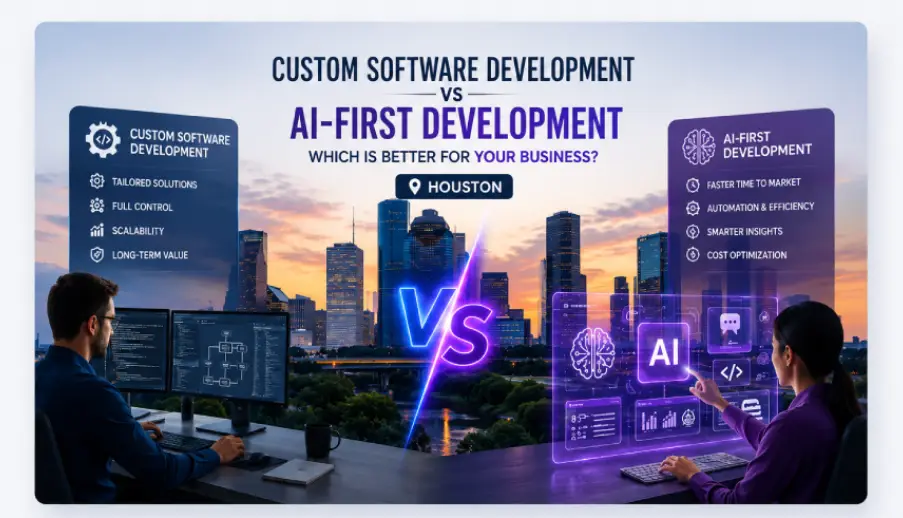
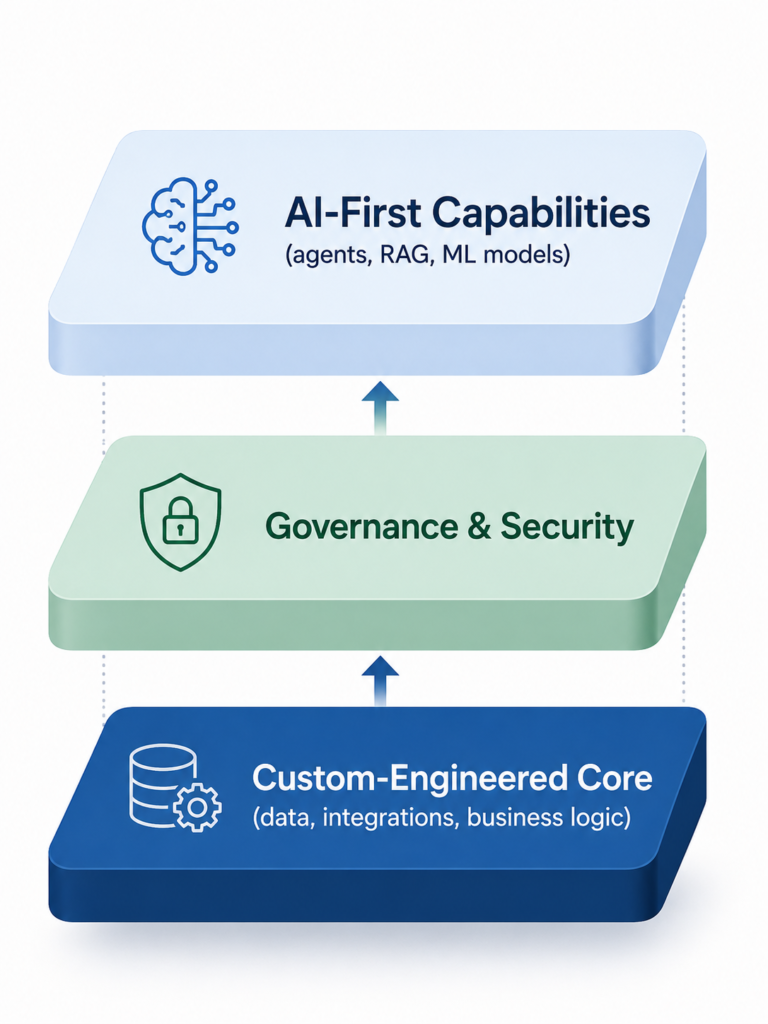
Custom software development builds a system around your exact business rules with full control over every line of code. AI-first development designs the product around machine learning, automation, and AI agents from day one, so intelligence is the core of the product rather than a feature bolted on later. Neither is universally “better.” Custom software wins when you need deterministic, tightly controlled, deeply integrated systems. AI-first wins when the value comes from prediction, personalization, language, or automating judgment-heavy work. For most Houston businesses, the smart answer in 2026 is a hybrid: a custom-engineered core with AI-first capabilities layered where they move a real number. If you want a straight recommendation for your situation, book a free software strategy session and we’ll map it to your goals.
Key Takeaways
- Custom software = a bespoke system engineered to your specifications. Maximum control, deep integration, predictable behavior.
- AI-first development = building the product’s core logic around AI (machine learning, LLMs, AI agents) rather than treating AI as an add-on.
- Cost: Custom software has higher upfront build cost; AI-first can be faster to a working prototype but carries ongoing model, data, and inference costs plus governance overhead.
- ROI: Custom ROI comes from process fit and efficiency. AI-first ROI comes from scale, personalization, and automating expensive human judgment, but returns are uneven. Only about 6% of organizations capture significant enterprise value from AI so far (McKinsey, 2025).
- The real decision is not “which technology” but “what problem am I solving, how much control do I need, and where does intelligence create value?”
- Most winners combine both. Roughly a third of organizations have actually scaled AI beyond pilots; the differentiator is execution, not the tool.
The Short Answer: It’s Not Either/Or (But the Difference Matters)
Ask ten founders whether they should build “custom software” or go “AI-first,” and most are really asking a different question: How do I build something that solves my problem, fits my budget, and won’t be obsolete in eighteen months?
Here’s the framing that saves you money. Custom software development and AI-first development are not competing products you pick from a shelf. One describes how much of the system is tailored to you. The other describes what sits at the center of the product’s intelligence. You can build custom software that is AI-first. You can also build AI-first software on a mostly off-the-shelf stack. The two ideas overlap.
What matters for your decision is the underlying trade-off: control and precision on one side, adaptive intelligence and automation on the other. Get that trade-off right for your specific workflow, industry, and risk tolerance, and you’ll spend less and ship something that lasts. Get it wrong, and you’ll join the roughly two-thirds of AI initiatives still stuck in pilots, or the large software projects that run 45% over budget and deliver 56% less value than promised.
The rest of this guide gives you the frameworks, numbers, and industry-specific scenarios to make that call with confidence. Let’s define both clearly first.
What Is Custom Software Development?
Custom software development is the process of designing, building, and maintaining a software application tailored to the specific requirements of one organization, rather than buying a generic off-the-shelf product. Every workflow, data model, integration, and business rule is engineered to match how your company actually operates.
Think of it as the difference between a tailored suit and one off the rack. Off-the-shelf SaaS (like a generic CRM or ERP) forces you to bend your process to fit the tool. Custom software bends the tool to fit your process.
What custom development typically includes:
- Requirements discovery and architecture design
- A bespoke data model and database (SQL or NoSQL)
- Backend services and APIs (often Node.js, Python, Java, or .NET)
- A tailored frontend (React, Angular, or Vue)
- Integrations with existing systems (ERP, CRM, accounting, IoT sensors, legacy databases)
- Cloud infrastructure on AWS, Microsoft Azure, or Google Cloud
- Security, compliance, testing, deployment, and ongoing maintenance
Custom software is the right call when:
- Your competitive advantage lives in a unique process no vendor sells
- You need deep integration with legacy or industry-specific systems
- Compliance and data control are non-negotiable (healthcare, finance, energy)
- You need deterministic, auditable behavior the same input must always produce the same output
- You expect to scale a proprietary platform over years
The main trade-off is upfront investment and time. You’re funding a build, not a subscription. But you own the asset, you control the roadmap, and you’re not held hostage by a vendor’s pricing or feature decisions.
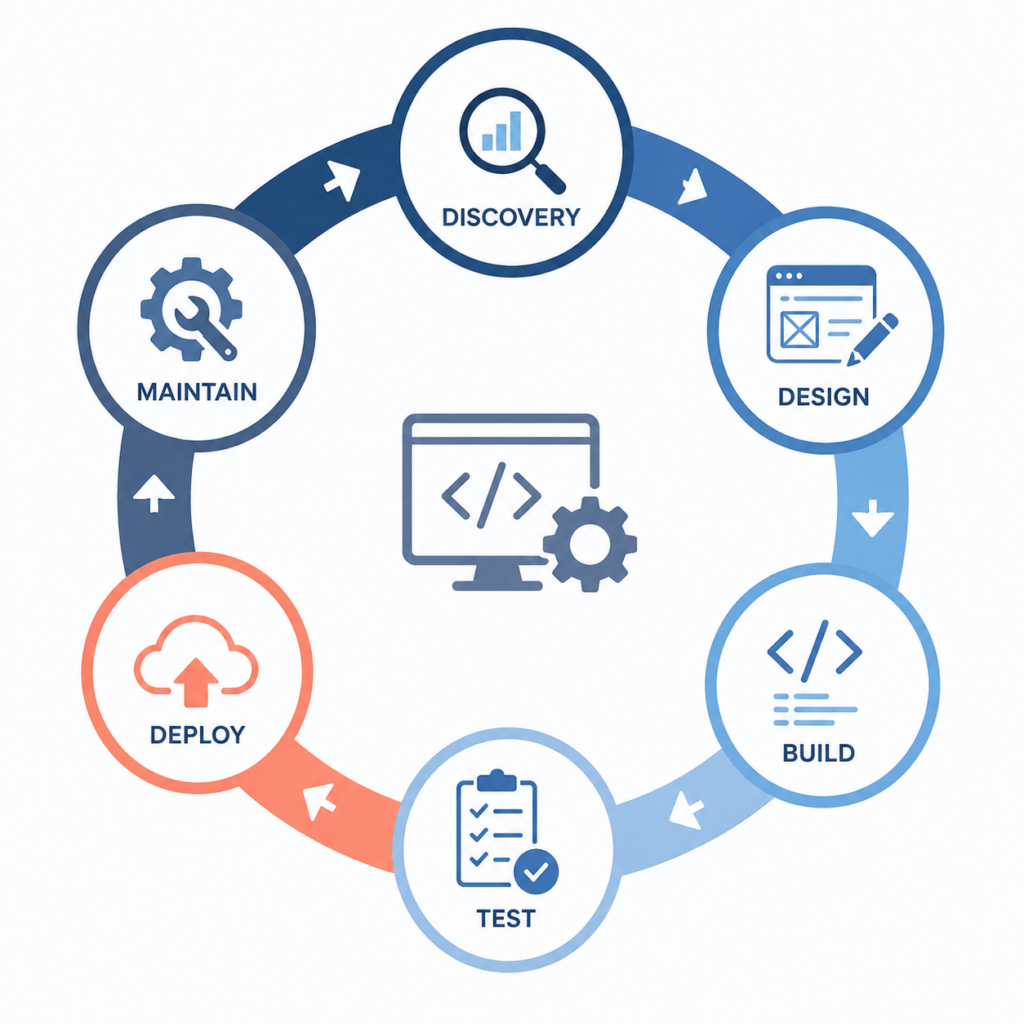
explore our approach to custom software development and enterprise application development.
What Is AI-First Development?
AI-first development is a product and engineering philosophy in which artificial intelligence is the core of the product from the start, not a feature added later. Instead of building a traditional application and sprinkling in a chatbot, the system is architected so that machine learning models, large language models (LLMs), and AI agents drive the primary value.
This is an important distinction, because “AI-first” gets used two ways, and conflating them causes expensive mistakes:
- AI-first product design — the product’s central capability is the AI. Examples: a diagnostic tool that reads medical images, a demand-forecasting engine, an autonomous customer-service agent, a document-processing system that extracts and reasons over contracts.
- AI-assisted development — using AI coding tools (like GitHub Copilot or Claude) to build software faster. This speeds up how you build, but the end product may be perfectly traditional.
When people debate “custom vs AI-first,” they usually mean sense #1: should the product be built around intelligence?
What AI-first development typically involves:
- Machine learning models and/or foundation models (GPT-class models, Claude, Gemini, open-source LLMs)
- A data pipeline and data engineering layer (clean, labeled, governed data is the fuel)
- Retrieval-augmented generation (RAG) and vector databases for grounding AI in your own knowledge
- Orchestration frameworks (such as LangChain) and AI agents that take multi-step actions
- Prompt engineering, evaluation, and guardrails
- MLOps: monitoring, retraining, and versioning models in production
- Human-in-the-loop checkpoints for high-stakes decisions
AI-first is the right call when:
- The core value comes from prediction, classification, personalization, or natural language
- You’re automating judgment-heavy, repetitive knowledge work
- You have (or can build) quality data to train and ground the system
- The problem tolerates probabilistic answers with human oversight
- Personalization at scale is the differentiator
The trade-off is different from custom software. AI-first products can reach a compelling prototype quickly, but they carry ongoing costs most teams underestimate: inference/API bills, data engineering, model governance, and the reality that AI outputs are probabilistic. That last point is the crux. A traditional function returns the same answer every time. An AI model returns a likely answer, which is powerful for some problems and unacceptable for others.
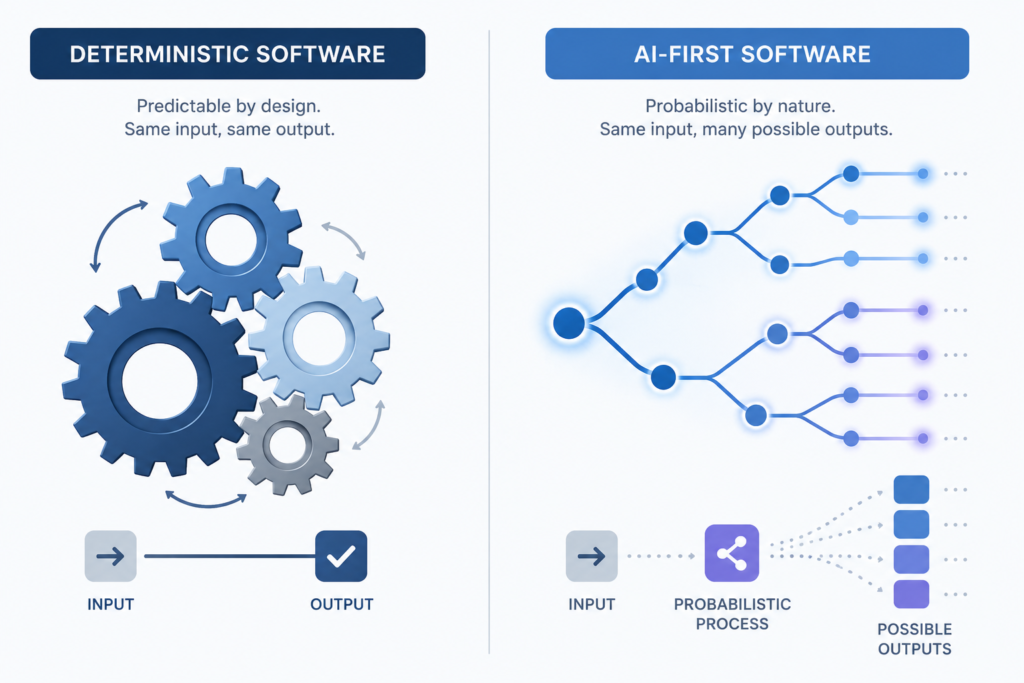
see our AI-driven custom development and business process automation services.
Side-by-Side Comparison
| Dimension | Custom Software Development | AI-First Development |
|---|---|---|
| Core value | Precise fit to your process | Intelligence, prediction, automation |
| Behavior | Deterministic, auditable | Probabilistic, adaptive |
| Best for | Unique workflows, deep integrations, compliance | Forecasting, personalization, language, judgment automation |
| Time to first working version | Slower (full build) | Faster prototype, longer to production hardening |
| Upfront cost | Higher | Moderate to build, variable to run |
| Ongoing cost | Maintenance and hosting | Inference/API, data pipelines, model governance, retraining |
| Data dependency | Moderate | High quality data is mandatory |
| Control | Full control of every line | Shared with model behavior and providers |
| Scalability | Scales with architecture | Scales with data and compute |
| Security/compliance | Highly controllable | Requires added governance, data handling care |
| Maintenance | Predictable, code-driven | Ongoing models drift and need monitoring |
| Vendor lock-in risk | Low (you own it) | Moderate (model/provider dependence) |
| Ideal team | Software engineers, architects | ML engineers, data engineers, plus software engineers |
Use this table as a quick screen. If your answers cluster on the left, lean custom. If they cluster on the right, lean AI-first. If they’re split, you’re a hybrid candidate which is where most businesses land. Talk to our team to pressure-test where you fall.
Cost Comparison: What You’ll Really Pay
Cost is where decisions get emotional, so let’s be concrete about structure rather than throwing around a single magic number. Real pricing depends on scope, complexity, integrations, and team location but the shape of the cost is predictable.
| Cost Element | Custom Software | AI-First |
|---|---|---|
| Discovery & design | One-time, essential | One-time, plus data feasibility assessment |
| Core build | Largest upfront line item | Prototype cheaper; production hardening adds up |
| Data work | Standard database work | Significant collection, cleaning, labeling, pipelines |
| Infrastructure | Cloud hosting, scales with usage | Cloud + GPU/inference or per-token API costs |
| Third-party/model fees | Minimal | Ongoing model/API licensing (OpenAI, Anthropic, cloud AI) |
| Governance & compliance | Built into engineering | Extra: evaluation, guardrails, monitoring, audit |
| Maintenance | Predictable | Ongoing retraining and drift monitoring |
The counterintuitive truth: AI-first looks cheaper because you can demo something impressive fast. But the cost curve is different. Custom software front-loads cost; AI-first spreads it across ongoing data, inference, and governance. Teams routinely underestimate the “last mile” moving an AI prototype into secure, reliable production. This is a major reason two-thirds of organizations remain stuck in pilot mode rather than scaling AI across the enterprise.
Meanwhile, the biggest hidden cost in any build is failure. Standish Group research across roughly 50,000 projects found only about 31% succeed on time, on budget, and in scope, while around 19% fail outright and about half are “challenged.” Large projects fare worse. The cost you should fear most isn’t the quote it’s the rebuild.
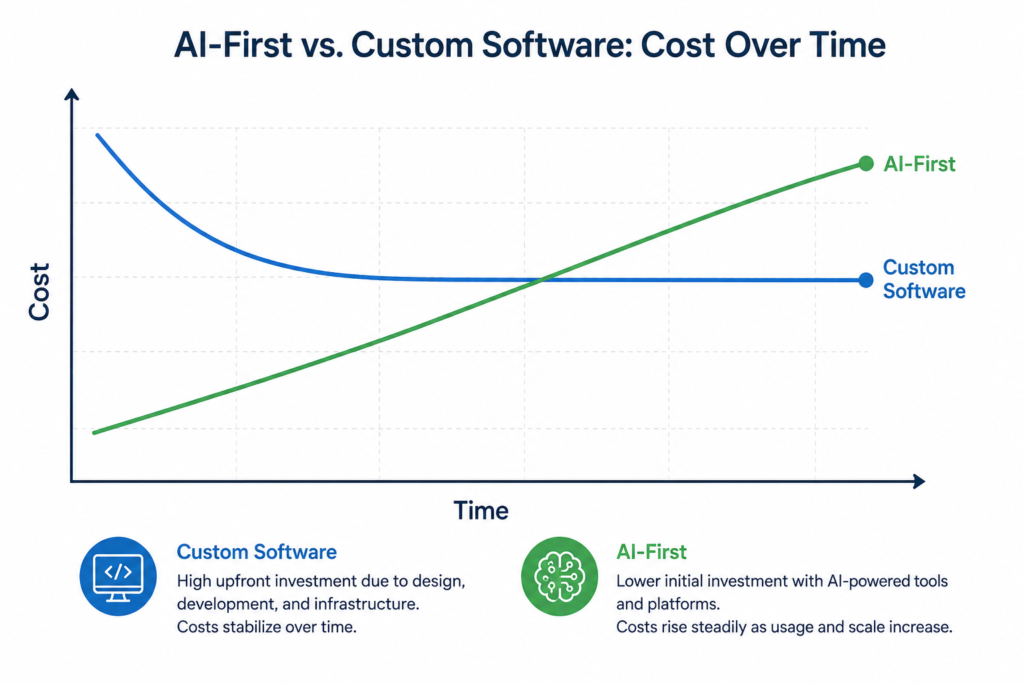
Want a realistic budget range for your specific project? A short scoping conversation beats any generic estimate. Request a free consultation and we’ll give you a grounded range, not a guess.
ROI Comparison: Where the Returns Come From
The two models generate returns in different ways, and understanding this prevents you from expecting the wrong kind of payback.
| ROI Driver | Custom Software | AI-First |
|---|---|---|
| Primary return | Efficiency, process fit, error reduction | Scale, personalization, automated judgment |
| Speed of payback | Steady and predictable | Uneven high when it works, slow when it stalls |
| Where value shows up | Ops savings, throughput, fewer manual steps | Revenue lift, cost avoidance, customer experience |
| Risk to ROI | Scope creep, poor adoption | Pilot purgatory, unclear KPIs, data quality |
| Measurability | Clear, direct | Requires disciplined metrics tied to outcomes |
The AI opportunity is real and large. Worldwide AI spending is forecast to reach roughly $2.59 trillion in 2026, up about 47% year over year (Gartner). Among executives deploying generative AI, many report first-year returns Google Cloud research found around 74% seeing ROI in the first year. But the returns are concentrated. McKinsey’s 2025 State of AI survey found that while about 88% of organizations now use AI in at least one function, only about 6% qualify as “high performers” capturing significant enterprise-level value.
The lesson for ROI is blunt: AI doesn’t create value by itself. Value shows up when the AI is wired into a redesigned workflow with clear metrics and leadership behind it. Custom software ROI is more predictable but capped by the efficiency of the process it encodes. The highest returns often come from combining the two a well-engineered system with AI applied precisely where it changes an outcome.
AI-First vs AI-Augmented Development and What It Means for Startups
AI-first development designs the product around AI capabilities from the ground up; AI-augmented development adds AI to an otherwise conventional build. For most startups, an AI-augmented approach is lower-risk: you ship a solid core product and layer in AI where it demonstrably improves the experience, rather than betting the whole architecture on it.
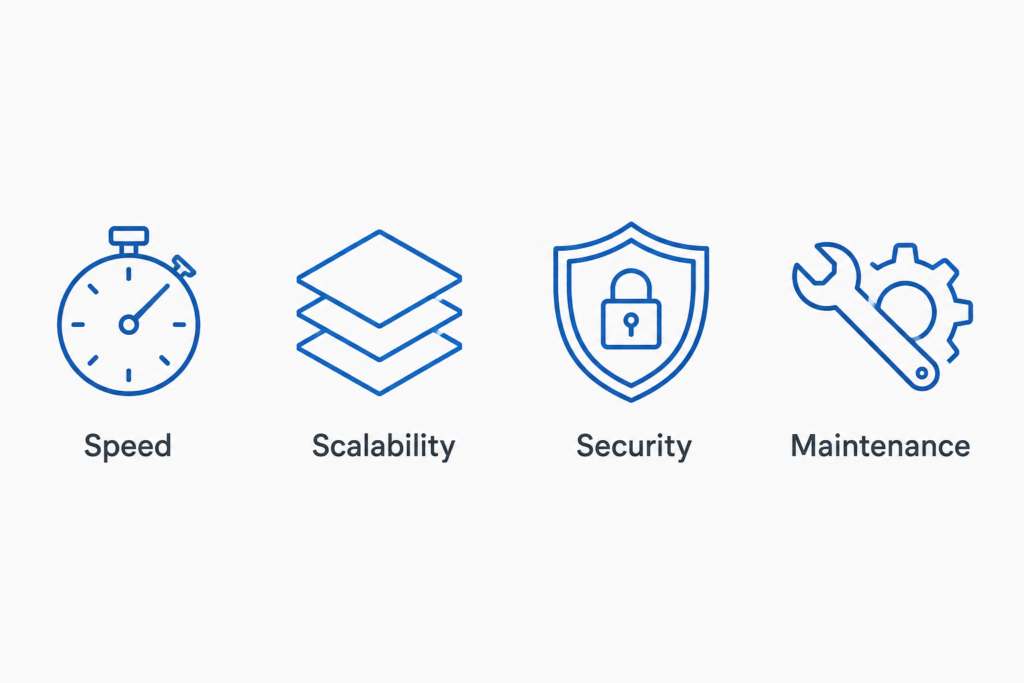
Speed, Scalability, Security, and Maintenance
These four questions come up in almost every buyer conversation, so let’s answer them directly.
Which Is Faster to Build?
AI-first often reaches a working prototype faster; custom software reaches production reliability more predictably. Foundation models let a small team stand up an impressive demo in days. But there’s a gap between “impressive demo” and “safe, reliable, integrated production system,” and AI-first projects spend a lot of time in that gap.
AI has also changed the speed of building both kinds of software. In a controlled GitHub study, developers using an AI coding assistant completed a task about 55% faster than those without. But the picture is nuanced: a 2025 randomized study found experienced developers were actually about 19% slower on complex, unfamiliar codebases with early AI tooling. Speed depends heavily on the task, the team, and the maturity of the tools. Anyone promising blanket “10x faster” is selling, not engineering.
Which Scales Better?
Custom software scales with architecture; AI-first scales with data and compute. A well-architected custom system scales predictably you add servers, optimize databases, and design for load. AI-first scales in a different dimension: more data improves the models, and more compute serves more inference, but costs rise with usage (especially per-token API costs) and quality can degrade if data governance slips. Both scale well when engineered properly. Neither scales well when rushed.
Which Is More Secure?
Custom software gives you tighter, more direct control over security; AI-first requires additional governance to reach the same assurance. With custom software, you control the code, the data flows, and the attack surface. AI-first introduces new considerations: where does your data go when it hits a model provider, how do you prevent sensitive data leakage, how do you defend against prompt injection, and how do you audit a probabilistic system? None of this makes AI-first insecure regulated industries deploy it every day but it demands deliberate architecture: private deployments, data isolation, retrieval instead of training on sensitive data, and human-in-the-loop review. For Houston’s healthcare and financial-services companies, this governance layer isn’t optional; it’s the price of entry.
Which Requires Less Maintenance?
Custom software has more predictable maintenance; AI-first requires ongoing model care. Traditional code does what it did yesterday. AI models drift the world changes, data shifts, and model behavior can degrade, so you need monitoring, evaluation, and periodic retraining. AI-first isn’t “set and forget.” Budget for MLOps the way you’d budget for hosting.
Which Is Better for Startups vs Enterprises?
The right model shifts depending on your stage, and the reasoning is different for each.
For startups and small businesses:
Startups usually need to prove a hypothesis fast and preserve cash. That points toward pragmatism, not purity. Start with off-the-shelf tools where they suffice, invest custom development in the one or two workflows that are your edge, and go AI-first only where intelligence is the actual product. A common winning pattern: a lean custom core plus targeted AI features that create obvious differentiation. Avoid building heavy custom infrastructure for problems a proven SaaS already solves spend those dollars on your moat.
For enterprises and larger organizations:
Enterprises carry legacy systems, compliance obligations, and scale. Here, deep custom development and integration usually pay off because the process complexity and integration surface are too specific for generic tools. AI-first initiatives at enterprises succeed when they’re tied to a redesigned workflow with clear ownership not when they’re isolated experiments. Larger companies are more likely to have actually scaled AI, but even they cite workflow, data, and operating-model blockers as the reason pilots stall. The enterprise advantage isn’t more pilots; it’s the discipline to move from pilot to production.
Quick heuristic:
- Startup: Buy what you can, build what differentiates, add AI where it’s the product.
- Growth-stage: Custom core, AI-first features on top, obsessive focus on data quality.
- Enterprise: Deep custom integration for complex processes, governed AI-first capabilities tied to measurable outcomes.
Not sure where your organization fits? Book a discovery call and we’ll match the model to your stage.
Industry Use Cases: Houston Edition
Houston is one of the best places in the country to see this trade-off play out. The city holds the second-largest concentration of Fortune 500 companies within its city limits (Technology.org), and its core industries energy, healthcare, and advanced manufacturing are precise, data-rich, and undergoing large-scale digital transformation, per the Greater Houston Partnership. By one regional workforce analysis, the majority of Houston’s tech professionals are embedded inside energy, healthcare, and aerospace companies rather than pure software firms (Nucamp) Houston is, in effect, a capital of applied technology, where software solves monumental physical problems. That makes the custom-vs-AI-first decision unusually concrete here.
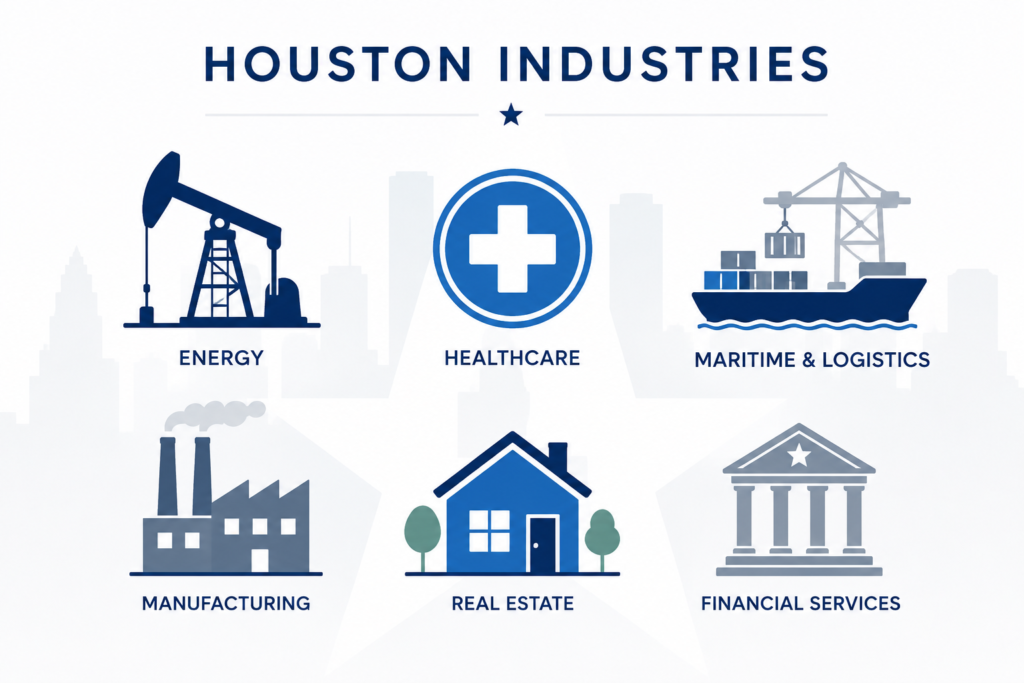
Energy & Oil and Gas
Houston’s energy majors and oilfield-services firms run enormous, safety-critical operations, and the Greater Houston Partnership notes these sectors are undergoing massive digital transformation. Custom software is essential for controlling proprietary equipment, integrating IoT sensor data across rigs and pipelines, and meeting strict operational and safety standards where deterministic behavior matters. AI-first shines in predictive maintenance (forecasting equipment failure before it happens), seismic and geological data analysis, energy trading models, and grid optimization Houston-headquartered enterprise-AI firm C3 AI, for instance, uses big data and IoT to improve asset performance and predict shortfalls before they occur (Built In). The winning pattern: a custom operational backbone with AI-first predictive analytics layered on the sensor data it already collects.
Healthcare & Life Sciences
Anchored by the Texas Medical Center described by the Greater Houston Partnership as the largest medical center in the world and institutions like MD Anderson, Houston’s healthcare sector is data-rich and heavily regulated. Custom software handles compliant patient systems, EHR integrations, and auditable clinical workflows. AI-first drives medical imaging analysis, clinical decision support, patient risk prediction, and bioinformatics pipelines that decode genomic data the kind of cancer-genome analysis run at MD Anderson (Nucamp). HIPAA compliance and human-in-the-loop review are mandatory, which is exactly why the custom-plus-governed-AI hybrid dominates here.
Logistics & Supply Chain
With Port Houston, four deepwater ports, and two major airports (Greater Houston Partnership), logistics is in the city’s DNA. Ports handle over 90% of global trade, and the Greater Houston Port Bureau reports that AI and automation are already redefining port operations for efficiency, security, and resilience. Custom software manages complex routing, warehouse operations, and integrations across carriers and customs systems. AI-first delivers demand forecasting, route optimization, dynamic pricing, and predictive delay detection. Logistics is a textbook hybrid case: deterministic systems of record plus AI-first optimization on top.
Manufacturing
Houston’s advanced manufacturers benefit from custom software for shop-floor control, quality systems, and ERP integration, and from AI-first approaches for predictive maintenance, computer-vision defect detection, and production optimization the core Industry 4.0 toolkit that Houston’s Smart Manufacturing & Automation Convention is organized around, spanning predictive maintenance, IIoT, digital twins, and robotics. The AI is only as good as the sensor and process data feeding it another reason data engineering, not the model, is the real work.
Real Estate & PropTech
Houston’s growth fuels an active real estate and PropTech scene; global security firm Allegion recently acquired Gatewise, a Houston-based PropTech SaaS provider (Wellesley Hills Financial). Custom software powers property management platforms, transaction systems, and portfolio tooling. AI-first enables valuation models, lead scoring, document processing for closings, and personalized recommendations. PwC and the Urban Land Institute report that proptech is moving AI from experimentation into adoption for property valuation and predictive maintenance, and MIT Sloan highlights real-estate fintech models such as fractional ownership and tokenized assets. For most firms, custom transaction infrastructure with AI-first analytics is the sweet spot.
Financial Services
Houston’s financial-services firms operate under strict regulation. Custom software handles core systems, compliance workflows, and auditable transactions where determinism is required including platforms for insurance and regulated financial services. AI-first powers fraud detection, credit risk modeling, document automation, and customer-service agents. McKinsey documents banks using generative AI to draft suspicious-activity reports, improve transaction monitoring, and accelerate the end-to-end credit process, while IBM notes AI models analyzing vast transaction datasets to flag patterns that indicate fraud. Explainability and governance are non-negotiable, so AI here is deployed with tight controls and human review.
SaaS Companies
For Houston’s growing SaaS sector one of the city’s fastest-expanding startup clusters (Greater Houston Partnership) the calculus is different: the software is the product. Here, custom development builds the platform, and AI-first features (intelligent search, automation, copilots, personalization) are increasingly what differentiate a product in a crowded market. The best SaaS teams treat AI as a core capability, not a marketing checkbox.
Can AI Replace Traditional Software Development?
Short answer: no but it’s changing it profoundly.
AI is not replacing the need for well-engineered software. Deterministic systems, databases, integrations, and business logic still run the world, and they still need to be designed, built, secured, and maintained by skilled people. What AI is doing is two things:
- Changing how software gets built. AI coding tools accelerate parts of development, automate boilerplate, and help with testing and review. Skilled engineers get a productivity boost though, as the research shows, the gains are real for some tasks and negative for others. Judgment still matters most.
- Changing what software can do. AI-first capabilities let software handle language, prediction, and judgment-heavy tasks that were previously impossible or required armies of people.
The realistic 2026 view, echoed by Gartner analysts, is that this is the “inflection year” where enterprises move from tactical AI experiments toward embedding AI into real operations but most organizations still favor incremental efficiency gains over wholesale transformation, and proving business value remains the hard part. AI is a powerful new capability inside the software toolbox, not a replacement for the toolbox. The companies that win pair strong software engineering with applied AI. That’s the whole argument for a hybrid approach.
When to Combine Both: The Hybrid Playbook
For most Houston businesses, the honest recommendation isn’t “custom” or “AI-first” it’s a deliberate combination. Here’s a practical playbook.
Step 1 — Build a solid, custom-engineered core. Your systems of record, integrations, and business-critical workflows should be reliable, secure, and deterministic. This is your foundation.
Step 2 — Identify where intelligence changes an outcome. Look for judgment-heavy, repetitive, or prediction-shaped work: forecasting, classification, document processing, personalization, support. These are AI-first candidates.
Step 3 — Layer AI-first capabilities on your own data. Use retrieval (RAG) and vector databases to ground AI in your proprietary knowledge instead of generic answers. Keep sensitive data controlled.
Step 4 — Wire AI into redesigned workflows, not around old ones. Bolting AI onto an unchanged process produces marginal gains. Redesigning the workflow around the AI is where value comes from this is the single biggest differentiator between companies that scale AI and those that don’t.
Step 5 — Measure ruthlessly and govern. Tie every AI capability to a KPI. Add evaluation, guardrails, monitoring, and human review for high-stakes decisions.
This is how the roughly one-third of organizations that have actually scaled AI operate. The tool is not the differentiator. Execution is.
The Buyer’s Guide: How to Choose
Use this decision framework before you hire anyone. Answer honestly.
Decision Framework 6 Questions:
- What problem am I actually solving? If it’s a unique process, lean custom. If it’s prediction/language/personalization, lean AI-first.
- How much control and predictability do I need? High-stakes, auditable, regulated → custom-heavy with governed AI.
- Do I have quality data? AI-first without clean, governed data will disappoint. No data readiness → fix that first.
- What’s my time and budget shape? Need a fast prototype to test a hypothesis → AI-first prototype. Need a durable platform → invest in custom architecture.
- What happens if the answer is wrong? If a wrong output is catastrophic (clinical, financial, safety), you need determinism and human review.
- Where’s my competitive moat? Spend custom effort there; buy or use AI for everything else.
Pre-Hire Checklist for a Software Development Partner:
- Do they ask about your business and data before pitching technology?
- Can they show relevant work in your industry? (Ask for case studies.)
- Do they explain when not to use AI, or do they pitch AI for everything?
- Do they have both software engineering and data/ML expertise in-house?
- How do they handle security, compliance, and data governance?
- What’s their plan for maintenance, monitoring, and (for AI) model drift?
- Do they design for measurable outcomes, or just deliverables?
- Do you own the code and the IP?
- Can they articulate a hybrid strategy, not just one approach?
If a vendor can’t clear this checklist, keep looking. A partner who recommends the right tool even when it’s the less expensive one is worth more than one who defaults to whatever’s trendy. Contact our team and put us through this checklist.
Common Mistakes to Avoid
- Chasing “AI” as a buzzword. Adding AI because competitors did, without a defined outcome, produces expensive pilots that go nowhere. Two-thirds of AI efforts stall exactly here.
- Building custom software for a solved problem. If proven SaaS handles it, custom is wasted spend. Save custom budget for your differentiator.
- Underestimating data work. For AI-first, data collection, cleaning, and governance are the majority of the effort. Skipping it guarantees disappointing results.
- Ignoring the “last mile” to production. A demo is not a product. Security, reliability, and integration are where projects live or die.
- Bolting AI onto unchanged workflows. Marginal gains at best. Redesign the process around the capability.
- No success metrics. If you can’t measure it, you can’t prove ROI and the project loses funding.
- Choosing a vendor who only sells one hammer. If everything looks like a nail, you’ll overpay for the wrong solution.
- Forgetting maintenance and drift. Both models need ongoing care; AI-first especially.
Myths vs Facts
| Myth | Fact |
|---|---|
| “AI-first is always cheaper and faster.” | It’s often faster to prototype, but ongoing data, inference, and governance costs add up. Total cost depends on the problem. |
| “AI will replace our developers.” | AI accelerates skilled developers and expands what software can do; it doesn’t remove the need for engineering judgment. |
| “Custom software is outdated in the AI era.” | Deterministic, integrated systems still run critical operations. AI layers on top; it doesn’t erase the core. |
| “If we deploy AI, ROI is automatic.” | Only about 6% of organizations capture significant enterprise value. ROI requires workflow redesign and metrics. |
| “Off-the-shelf is always cheaper than custom.” | Not when it forces costly workarounds, integrations, and per-seat fees at scale. Sometimes custom is cheaper long-term. |
| “AI-first means no humans in the loop.” | For high-stakes decisions, human oversight is a feature, not a failure. |
| “More data always means better AI.” | Only if it’s clean and governed. Bad data at scale makes things worse. |
Hidden Costs to Watch For
Custom software hidden costs:
- Scope creep from unclear requirements
- Integration complexity with legacy systems
- Ongoing maintenance and technical debt
- Poor user adoption if change management is skipped
AI-first hidden costs:
- Data engineering (usually the biggest surprise)
- Inference/API bills that scale with usage
- Governance, evaluation, and monitoring infrastructure
- Model retraining and drift management
- Compliance and audit overhead in regulated industries
Shared hidden cost: the price of getting it wrong. With only about 31% of software projects fully succeeding, the most expensive path is the rebuild after a failed first attempt. This is precisely why the discovery and architecture phase often the part buyers want to skip is the cheapest insurance you can buy.
Future Trends: 2026 and Beyond
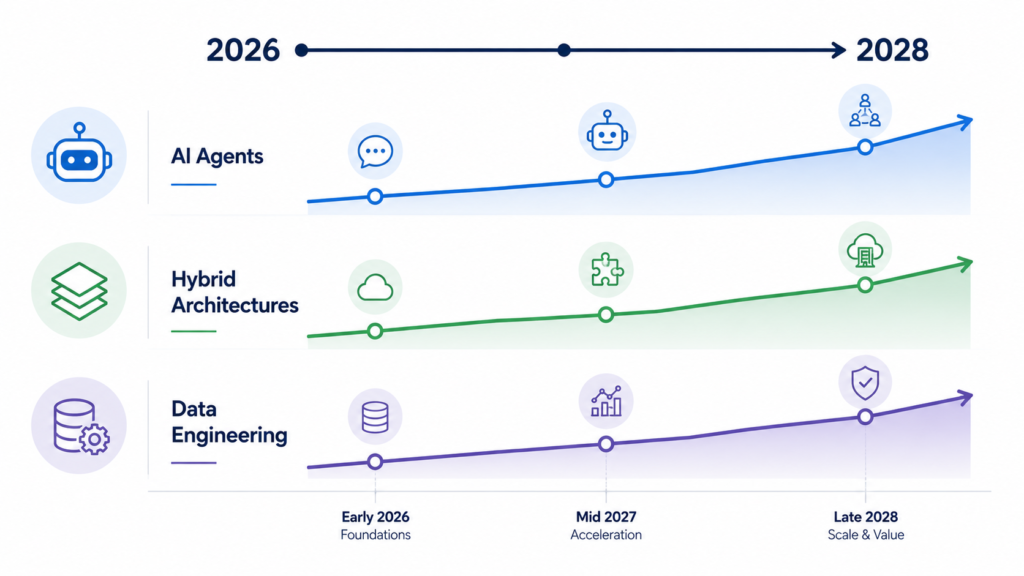
- Agentic AI moves from hype to workflows. AI agents that take multi-step actions are being embedded into real operations. Gartner projects meaningful growth in agent adoption as enterprises integrate them into multistep business processes.
- 2026 is the enterprise “inflection year.” Analysts expect enterprises to shift from tactical AI experiments toward operational deployment with proving value as the central challenge.
- Software spending stays strong. Worldwide IT spending is forecast to exceed $6 trillion in 2026, with software above $1.4 trillion and generative AI among the fastest-growing segments (Gartner).
- Hybrid becomes the default architecture. Custom-engineered cores with governed AI-first capabilities layered on top will be the standard pattern, not the exception.
- Data engineering becomes the competitive moat. As models commoditize, your proprietary, well-governed data is the durable advantage.
- Governance becomes a first-class discipline. Evaluation, guardrails, and human-in-the-loop review move from afterthought to requirement, especially in regulated Houston industries.
- The scaling gap persists. The divide between the roughly one-third scaling AI and the two-thirds stuck in pilots will define winners and losers.
Final Verdict
So, which is better custom software development or AI-first development?
Neither, on its own. The winner is the one that fits your problem and for most businesses, that’s a deliberate hybrid.
Choose custom software when you need control, precision, deep integration, and deterministic, auditable behavior. Choose AI-first when the core value is prediction, personalization, language, or automating judgment-heavy work and you have the data and governance to support it. Choose both, in a deliberate architecture, when you want a reliable core and intelligence applied exactly where it changes an outcome. That last option is where the strongest ROI lives, and it’s where the roughly one-third of organizations that have actually scaled AI operate.
The technology is not the hard part. The hard part is matching the right approach to your specific workflow, industry, risk profile, and data reality then executing with discipline. That’s a decision worth making with an experienced partner who will recommend the right solution, not the trendiest one.
Ready to make the call with confidence? Request a free consultation or book a discovery call. We’ll assess your goals, data, and constraints, and give you a clear, honest recommendation custom, AI-first, or hybrid mapped to real outcomes for your business.
Frequently Asked Questions
What’s the difference between custom software and AI-first development? Custom software is a system engineered to your exact requirements with full control and deterministic behavior. AI-first development builds the product’s core around AI machine learning, LLMs, and agents so intelligence is central rather than added later. Custom describes how tailored the system is; AI-first describes what sits at the product’s core.
Is AI-first development cheaper than custom software? Sometimes to prototype, rarely overall. AI-first can reach an impressive demo faster, but ongoing data engineering, inference/API costs, and governance often make total cost comparable or higher. The honest answer depends on your specific problem, which is why a scoping conversation beats a generic quote.
Which is faster to build? AI-first usually reaches a working prototype faster, while custom software reaches reliable production more predictably. AI tools have also sped up building both, though studies show gains vary widely by task and team some complex work is actually slower with early AI tooling.
Which has better ROI? It depends on the problem. Custom ROI is steady and predictable (efficiency, process fit). AI-first ROI can be higher but is uneven only about 6% of organizations capture significant enterprise value from AI. The best returns usually come from a hybrid approach with metrics attached.
Can AI-first software scale to enterprise level? Yes, when engineered and governed properly. AI-first scales with data and compute rather than just servers, and costs rise with usage. Enterprises succeed when AI is tied to redesigned workflows with clear ownership, not run as isolated pilots.
Is AI-first software secure enough for healthcare or finance? It can be, with the right architecture: data isolation, private deployments, retrieval instead of training on sensitive data, guardrails against prompt injection, and human-in-the-loop review. Houston’s healthcare and financial-services firms deploy AI daily, always with strong governance.
Does AI-first development require less maintenance? No it usually requires more ongoing care. Traditional code is stable; AI models drift as data and the world change, so you need monitoring, evaluation, and periodic retraining (MLOps). Budget for it like you budget for hosting.
Should a startup choose AI-first or custom? Be pragmatic. Buy proven SaaS where it suffices, invest custom development in your one or two differentiating workflows, and go AI-first only where intelligence is genuinely the product. Preserve cash for your moat.
Should an enterprise choose AI-first or custom? Usually both. Deep custom integration handles complex, compliant processes; governed AI-first capabilities are layered where they change outcomes. The enterprise advantage is the discipline to move AI from pilot to production.
Can AI replace software developers? No. AI accelerates skilled developers and expands what software can do, but engineering judgment, architecture, security, and integration still require people. The winning teams pair strong software engineering with applied AI.
When should I combine both approaches? Almost always. Build a reliable custom core, then layer AI-first capabilities on your own data where prediction, language, or automation create value wiring AI into redesigned workflows and measuring the results.
What are the biggest risks of AI-first development? Pilot purgatory (experiments that never scale), poor data quality, unclear success metrics, governance gaps, and probabilistic outputs in situations that require certainty. Most of these are execution problems, not technology problems.
What are the hidden costs of custom software? Scope creep, integration complexity, technical debt, ongoing maintenance, and poor adoption if change management is skipped. A thorough discovery and architecture phase is the cheapest way to avoid the biggest hidden cost: a rebuild.
How long does custom software take to build? It varies with scope and complexity, from a few months for a focused application to a year or more for a large platform. A discovery phase produces a realistic timeline; be skeptical of anyone quoting a firm timeline before understanding your requirements.
What industries benefit most from AI-first development? Any data-rich, judgment-heavy domain: energy (predictive maintenance, seismic analysis), healthcare (imaging, risk prediction), logistics (forecasting, routing), finance (fraud, risk), manufacturing (defect detection), and SaaS (intelligent product features).
Is my data safe when using AI models like OpenAI or Anthropic? It can be, depending on architecture and configuration. Options include private/enterprise deployments, keeping sensitive data out of training, using retrieval to ground models without exposing raw data, and applying strict access controls. Data handling should be designed deliberately, not assumed.
Is AI-first or traditional development better for a startup? It depends on whether AI is your product or supports it. If your differentiation is the AI itself, go AI-first; if AI is a feature, augment a conventional build. We help startups make that call before committing to an architecture.
How do I choose a software development company in Houston? Look for a partner with both software engineering and data/ML expertise, relevant industry experience, a clear stance on when not to use AI, strong security and governance practices, and a focus on measurable outcomes. Make sure you own the IP. Use the pre-hire checklist above.
What’s the first step to get started? A discovery conversation. Before writing any code, a good partner assesses your goals, data readiness, constraints, and where value lives then recommends custom, AI-first, or hybrid. Book a free software strategy session to take that first step.