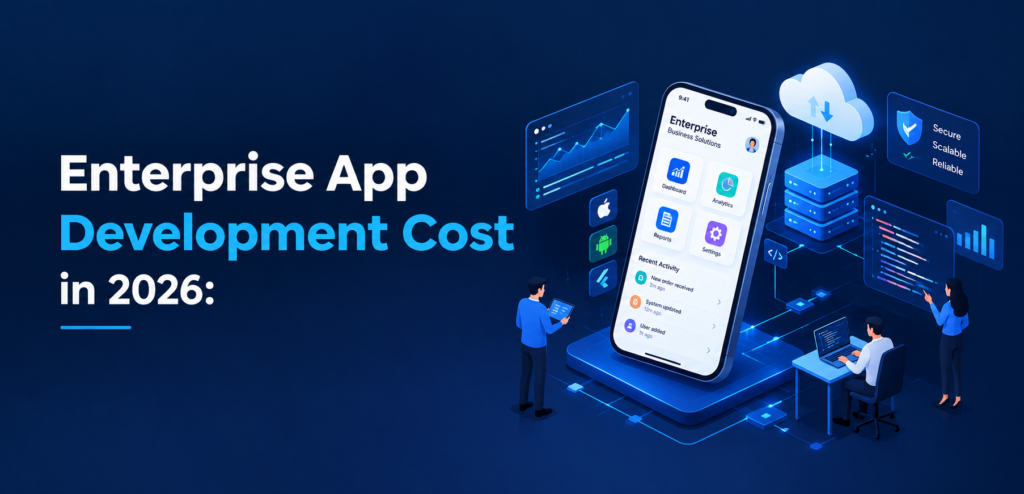
Most enterprise app projects begin with one question: “What is this going to cost us?” And most buyers get the same unsatisfying answer“it depends.”
It does depend. But it depends on a short, knowable list of things, and once you can see that list, you can estimate your own project within a usable range before you ever talk to a vendor. That is what this guide is for.
Here is the honest headline, for a U.S.-managed build in 2026:
The number that lands on your quote is driven by five things, roughly in this order of impact: how many existing systems it must integrate with, how regulated your data is, how many concurrent users it serves, what architecture it needs, and how much you’ll spend keeping it alive after launch. The rest of this guide puts dollar figures on each.
What counts as an “enterprise application” (and why it costs more)
An enterprise application isn’t just “a big app.” It’s software that becomes part of how an organization operates which means it inherits the organization’s complexity. In practice it has most of these attributes:
- Multiple user roles and departments (role-based access control, approval chains)
- Integrations with systems you already run (ERP, CRM, HR, data warehouse, payments)
- Security and often compliance obligations (SSO, audit logging, HIPAA/SOC 2/PCI)
- Scale — hundreds to tens of thousands of users, sometimes across regions
- A long life — it’s maintained, extended and supported for years, not shipped once
That last point is why enterprise software is expensive in a way a consumer app isn’t: you’re not paying for screens, you’re paying for the wiring behind them and for the years of reliability after launch.
Software spending backs this up. Gartner forecasts worldwide IT spending to reach $6.37 trillion in 2026, up 14.2%, with software one of the fastest-growing segments, on track to surpass $1.4 trillion globally. Enterprise software is where a large share of that goes.
Quick cost summary
Typical ranges for U.S.-managed delivery in 2026 planning estimates, not fixed quotes.
| Type of enterprise app | Users | Integrations | Estimated cost | Timeline |
| Departmental / single-workflow tool | 50–500 | 0–2 | $50,000 – $120,000 | 3–6 mo |
| Mid-market workflow platform | 500–5,000 | 3–6 | $120,000 – $300,000 | 6–12 mo |
| Company-wide / regulated system | 5,000+ | 7+ | $300,000 – $750,000+ | 12–20 mo |
| Legacy modernization / multi-region | 5,000+ | Many + legacy | $500,000 – $1.5M+ | 12–24+ mo |
The single most useful thing to know before comparing any quotes: write down two numbers first how many existing systems the app must read from or write to, and whether your data is regulated. Those two predict your final cost better than your entire feature list.
Cost by number of users: and the linearity myth
Buyers often assume 10× the users means 10× the cost. It doesn’t. Users influence cost through concurrency, data volume and reliability requirements, not head-count directly. An app used by 10,000 people who each log in once a week can be cheaper to build than one used by 800 people hammering it simultaneously in a warehouse.
How build cost shifts with scale (integrations moderate, compliance light).
| User scale | What actually changes | Estimated build impact |
| ~100 users (one team) | Simple hosting, basic RBAC, single region | Base: $50K – $120K |
| ~1,000 users (several depts) | SSO, more roles, moderate integrations, load testing | $150K – $350K |
| ~10,000+ users (org-wide) | High-availability architecture, caching, DB scaling, observability, multi-region | $400K – $900K+ |
What raises the user-driven portion: high concurrency (everyone at 9 a.m.), real-time features, heavy reporting, and uptime guarantees (SLAs). What lowers it: predictable usage, read-heavy workloads, and phased department-by-department rollout.
Cost by complexity
| Complexity | Description | Estimated cost |
| Basic | Forms, dashboards, RBAC, 0–2 modern integrations | $50K – $120K |
| Moderate | Cross-department workflows, SSO, 3–6 integrations, reporting | $120K – $300K |
| High | Legacy integration, compliance, offline/real-time, AI, multi-region | $300K – $750K+ |
Cost of integrations
Integration is usually 30–50% of the whole build, and the line item buyers under-estimate most, often by half. The cost isn’t in “connecting” it’s in testing, error handling and the undocumented behavior of the system on the other side. A clean modern API is cheap. A fifteen-year-old on-prem ERP with no documentation is detective work.
Typical add per integration.
| Integration | Typical add | What drives it |
| Modern REST/GraphQL API (documented SaaS) | $5,000 – $20,000 | Clean docs, sandbox, stable schema |
| CRM (Salesforce, HubSpot, Dynamics) | $10,000 – $40,000 | Field mapping, sync rules, dedupe |
| ERP (NetSuite, SAP, Oracle, Dynamics 365) | $25,000 – $120,000+ | Complex data models, transactional integrity |
| Legacy / on-prem / custom system | $30,000 – $150,000+ | No docs, brittle interfaces, data cleansing |
| Payment gateway (Stripe, Adyen) + PCI scope | $8,000 – $30,000 | Tokenization, reconciliation, compliance |
| Data warehouse / BI | $10,000 – $35,000 | ETL, scheduling, transformation |
Cost of security and compliance
Security is not optional in an enterprise build; compliance is the part that adds real dollars, because it adds design work, audit trails, encryption, formal testing and documentation. As a rule of thumb, a regulated build carries 15–30% more cost than the same app without compliance.
The budget case writes itself with one figure: according to IBM’s 2025 Cost of a Data Breach Report, the average cost of a data breach in the United States has hit an all-time high of $10.22 million. more than double the global average of $4.44M with healthcare the most expensive sector at $7.42M for the 15th year running. Spending 15–30% up front to avoid that is cheap insurance.
| Security / compliance item | Estimated cost | Note |
| Baseline security (encryption, secure SDLC, RBAC) | Often included – $15,000 | Should never be an add-on |
| SSO / SAML / OIDC + SCIM provisioning | $8,000 – $30,000 | Enterprise identity — a distinct line item |
| SOC 2 readiness (controls + audit prep) | $25,000 – $60,000 | Auditor fee separate: ~$10K–$40K/yr |
| HIPAA alignment (BAAs, audit logs, PHI) | $20,000 – $75,000 | Plus ongoing safeguards |
| PCI DSS (scope-dependent) | $15,000 – $100,000+ | SAQ-A is light; full scope is heavy |
| GDPR / CCPA data-rights tooling | $10,000 – $40,000 | Consent, export, deletion workflows |
Two things buyers miss: (1) SSO and RBAC are different costs SSO is “who are you,” RBAC is “what can you do.” (2) Compliance frameworks recur SOC 2 and PCI need re-certification annually, so they belong in your run-cost, not just your build.
Cost of architecture: RBAC, SSO and multi-tenancy
This is where competitor cost guides go quiet, and where a lot of budget actually lives.
- RBAC (role-based access control) — the difference between “one type of user” and “twelve roles with different permissions.” Complex permission matrices add $8,000–$25,000.
- Multi-tenant architecture — if your app serves multiple clients or business units from one codebase (SaaS-style), tenancy isolation, per-tenant configuration and “noisy neighbor” handling add $20,000–$70,000 versus single-tenant. Decide it in discovery retrofitting multi-tenancy later is one of the most expensive changes you can make.
Cost of data migration
Moving years of data from an old system is a workstream, not a task. The cost is driven by volume, how clean the source data is, and how much transformation and validation it needs. Typical enterprise data migration runs $15,000–$80,000+, and the expensive part is rarely the transfer it’s the cleansing and reconciliation (deduping, fixing malformed records, mapping old fields to a new model) and proving nothing was lost.
Cost of specific features
| Feature | Estimated add | Why |
| Offline-first sync | $10,000 – $35,000 | Conflict resolution is genuinely hard |
| Real-time (websockets, live updates) | $8,000 – $30,000 | Infrastructure + state management |
| AI features (search, prediction, chat) | $20,000 – $80,000+ | Model integration, data pipelines, evaluation |
| Custom reporting / analytics | $10,000 – $40,000 | Query performance, export, scheduling |
| Advanced UI/UX for high-daily-use apps | $10,000 – $45,000 | Workflow design pays for itself at scale |
Cost by platform
| Approach | Cost vs single native | Mid-tier enterprise cost | Trade-off |
| Progressive Web App | 60–75% | $50K – $130K | No deep hardware access, weaker offline |
| Single native (iOS or Android) | 100% (baseline) | $80K – $200K | One platform |
| Cross-platform (Flutter / React Native) | 115–135% | $95K – $260K | Both platforms, minor native trade-offs |
| Dual native (separate iOS + Android) | 180–200% | $150K – $400K | Best performance, highest cost |
Is Flutter or React Native cheaper than native? For most enterprise use-cases, yes, one codebase for both platforms typically lands around 60% of the cost of building two native apps, with lower maintenance too. Native still wins when you need heavy device-level access, AR, or high-frame-rate media. Go Tech ships most enterprise mobile app development and web application development cross-platform for exactly this reason. For a deeper breakdown of web pricing, see our guide to web app development cost.
Cost by industry
Ranges driven by regulation and integration depth, not by sector “glamour.”
| Industry | Typical range | What drives it |
| Healthcare & clinical | $90K – $400K+ | HIPAA, EHR/HL7-FHIR integration, audit logging |
| Financial services & fintech | $100K – $450K+ | PCI DSS, KYC, core-banking integration |
| Manufacturing & industrial | $70K – $250K | ERP/MES integration, offline, device connectivity |
| Logistics & supply chain | $60K – $220K | WMS/ERP sync, GPS, poor-connectivity handling |
| Retail & multi-store | $50K – $180K | POS + inventory sync, real-time analytics |
| Real estate & PropTech | $55K – $170K | Document workflows, CRM/MLS, multi-entity |
For deeper industry context, Go Tech maintains dedicated pages for healthcare & clinical compliance, logistics & warehousing and real estate / PropTech. In financial services, our separate guide to fintech app development cost covers PCI DSS and KYC pricing in detail.
Development team cost: in-house vs agency vs nearshore vs offshore vs hybrid
There’s no universally “cheapest” model, there’s the right model for your risk tolerance, timezone needs and IP sensitivity. Here’s the honest comparison for typical 2026 U.S. market rates.
| Model | Typical rate | Mid-tier cost | Best for | Trade-off |
| In-house team | Salaried | $400K–$700K/yr | Core IP for years | Slow to hire; high fixed cost |
| U.S. agency | $100–$250/hr | $180K–$450K | Regulated, local presence | Highest hourly rate |
| Nearshore (LatAm) | $50–$100/hr | $110K–$260K | Overlapping U.S. hours | Fewer senior specialists |
| Offshore (S/SE Asia) | $25–$60/hr | $60K–$160K | Well-specified builds | Timezone + spec risk |
| Hybrid (U.S. PM + global eng.) | $45–$95 blended | $90K–$260K | Most mid-market projects | Needs a disciplined partner |
The trap in the rate table: a low hourly rate on a badly specified project is the most expensive thing you can buy. Rework on an under-specified offshore build routinely costs more than the original contract.
Where Go Tech sits: we run the hybrid model by design U.S.-based (Houston) project management and same-day communication, with senior global engineering. You get onshore accountability and time-zone overlap without paying a pure U.S.-agency rate. If you’d rather extend your own team, our dedicated development teams and developer augmentation sit between building in-house and outsourcing entirely.
Development timeline and cost by phase
The two phases that decide whether a build succeeds discovery and integration are the two that cheap quotes underfund. Skipping discovery doesn’t save money; it moves the cost to QA, where fixing a design mistake costs roughly ten times more.
Typical budget split, shown on a $250,000 build.
| Phase | Share | On a $250K build | What happens |
| 1. Discovery & scoping | 8–12% | $20K–$30K | Interviews, system audit, integration mapping |
| 2. Architecture & tech strategy | 6–10% | $15K–$25K | Data model, security architecture, scale plan |
| 3. UX/UI design | 10–15% | $25K–$37.5K | Workflows, prototypes, design system |
| 4. Core development | 40–50% | $100K–$125K | Frontend, backend, APIs, business logic, RBAC |
| 5. Integration & QA | 15–20% | $37.5K–$50K | Legacy connections, automated/load/security tests |
| 6. Deployment & rollout | 5–8% | $12.5K–$20K | Environments, data migration, phased release |
| 7. Support & iteration | 15–25%/yr | $37.5K–$62.5K/yr | SLA support, monitoring, updates, features |
Hidden costs and the 3-year total cost of ownership
The number on your build quote is not the number you’ll spend. Over three years, ongoing and post-launch costs typically add 50–90% on top of the build.
Three-year view on a $250,000 build.
| Hidden / ongoing cost | Typical amount | When it hits |
| Data migration & cleansing | $15K – $60K | Pre-launch |
| Third-party licenses & API fees | $500 – $5,000/mo | Ongoing |
| Cloud infrastructure | $500 – $8,000/mo (scales) | Ongoing |
| Change management & training | $8K – $35K | Launch + 6 months |
| Compliance audits & re-certification | $10K – $50K/yr | Annually |
| Monitoring, DevOps & incident response | $400 – $3,000/mo | Ongoing |
| Scope changes during build | 10–20% of build | Months 3–9 |
The TCO formula you can reproduce:
Worked example — a $250,000 build:
- Maintenance: ~$50K/yr × 3 = $150K
- Cloud infra: ~$3K/mo × 36 = $108K (varies widely with scale)
- Licenses/APIs: ~$1.5K/mo × 36 = $54K
- Change management + training (one-time): ~$20K
- Compliance recert (if regulated): ~$25K/yr × 3 = $75K
- 3-year TCO ≈ $410K–$500K on a $250K build, roughly 1.6×–2× the build.
SaaS vs. custom enterprise software: when does custom pay off?
This is the real build-vs-buy decision, and it comes down to break-even math, not opinion. Take 1,000 users on a SaaS tool at $40/user/month:
- SaaS: $40 × 1,000 × 12 = $480,000/year → $1.44M over 3 years
- Custom: $250K build + ~$50K/yr support + infra ≈ $450K–$500K over 3 years
In this scenario, custom breaks even inside the first year and saves roughly $900K+ over three years. But, and this matters SaaS includes hosting, updates, security patching and support in that price, and carries no build risk. So the honest rule is:
- Buy SaaS when your process is standard, your user count is modest, and speed-to-value matters more than fit.
- Build custom when the process is your competitive edge, when per-seat SaaS pricing punishes you for growing, or when no tool integrates with your existing systems the way you need.
Custom becomes financially justified roughly when your annual SaaS spend exceeds ~30–40% of a custom build’s cost, and you expect to run the software for 3+ years. Below that, buy. Above it, build. Go Tech’s custom software and business process automation teams model this break-even with clients before a line of code is written.
Why two vendors quote $75K and $300K for the “same” app
Because they’re almost never bidding on the same scope. One is building you a screen on top of an existing backend; the other is rewiring your operation. To normalize two wildly different quotes, line them up against this checklist the gaps explain the price difference.
What a real enterprise app quote should itemize
- 1. Discovery & scoping — is it a real phase, or assumed away?
- 2. Integrations — named individually with effort per system (not “integrations: included”)
- 3. Security & compliance — SSO, RBAC, encryption, audit logging; which frameworks
- 4. Architecture — single- vs multi-tenant; scale/HA assumptions
- 5. Data migration — volume, cleansing, validation
- 6. QA — automated, load and security testing (or just “we’ll test it”?)
- 7. Deployment & environments — dev/stage/prod, CI/CD, rollback
- 8. Post-launch — SLA, monitoring, maintenance rate, who owns the code
- 9. Assumptions & exclusions — the section that predicts your change orders
- 10. IP ownership — do you own the source code outright?
A $75K quote that omits half of these isn’t cheaper it’s incomplete, and the missing scope reappears as change orders. A $300K quote that itemizes all ten may be the lower-risk number.
How to reduce cost without cutting quality
Each lever below reduces cost by trimming scope or risk never quality.
- Phase by department — launch with one business unit, learn, then expand. Defers 40–60% of spend and de-risks the architecture.
- Lock integrations in discovery — price every later addition as a change order. Prevents the #1 budget overrun.
- Reuse existing infrastructure — extend your current identity provider, cloud and data platform. Can save $15K–$50K.
- Choose cross-platform for internal/field apps — one codebase, ~40% lower build and maintenance.
- Invest in discovery — a focused discovery phase prevents mistakes that cost 10× to fix later.
- Use AI where it fits — automate routine coding, testing and documentation, but keep integrations and security under senior oversight.
Example enterprise cost scenarios
Modeled examples that show how the cost drivers combine, not real client projects.
Scenario 1 — Internal workflow app for a 200–500-employee company
- Features: role-based dashboards, approval workflows, reporting, notifications
- Integrations: HRIS + one internal database (2, modern APIs)
- Users: ~400, single region, light compliance
- Estimated build: $90K–$160K · Timeline: 4–6 months
- Main cost drivers: workflow complexity, reporting, RBAC · Maintenance: ~$1,500–$3,500/mo
Scenario 2 — Mid-market ERP/CRM-connected platform
- Existing systems: NetSuite (ERP) + Salesforce (CRM) + data warehouse
- Integrations: 3–4, mixed API quality; real data migration
- Users: ~2,000 across departments; SSO required · Security: SOC 2 readiness
- Estimated build: $220K–$380K · Timeline: 8–12 months
- Risks: ERP data-model complexity, migration cleansing, reporting scope creep
Scenario 3 — Regulated healthcare application
- Compliance: HIPAA; audit logging; PHI encryption at rest/in transit
- Security architecture: SSO + granular RBAC; BAAs with vendors
- Integrations: EHR via HL7/FHIR + lab system
- Estimated build: $250K–$500K+ · Timeline: 10–16 months
- Maintenance: higher, due to annual compliance re-certification (~$25K–$50K/yr)
How Go Tech Solutions approaches enterprise projects
Go Tech Solutions is a Houston, Texas-based software development company that builds custom software and enterprise applications for startups and mid-market businesses, with clients across 7+ countries. We were founded by engineers, not salespeople, and we work as a product-engineering partner, not a body shop.
A few of our published enterprise projects:
- Mondelēz International — Visitor Management: an enterprise web application (React, TypeScript, PostgreSQL, Redis).
- Godaam Technologies — Warehouse Management System: a multi-vendor SaaS platform with inventory control and real-time analytics (React, Next.js, PostgreSQL, AWS).
- LifeRise Solutions — PropTech Admin Ecosystem: a centralized dashboard with 10+ modules, role-based access and automated booking workflows.
How we keep enterprise budgets honest:
- We itemize integrations, compliance and complexity up front—you know what you’re paying for before development starts.
- U.S.-based project management with same-day communication and same-timezone calls.
- Parallel QA—testing runs throughout the build, not bolted on at the end.
- Milestone-based billing—you pay for delivered work, and you own the code.
Frequently asked questions
How much does an enterprise app cost for 100 users?
A single-team app for ~100 users typically runs $50K–$120K, assuming light integrations and no heavy compliance. Users at this scale rarely drive the cost integrations and features do.
How much for 1,000 users? For 10,000+?
Around $150K–$350K for ~1,000 users (SSO, several integrations, real load testing) and $400K–$900K+ for 10,000+ multi-region users, where high-availability architecture and observability become the cost drivers.
How much does ERP integration add? CRM? Legacy?
ERP integration typically adds $25K–$120K+, CRM $10K–$40K, and undocumented legacy systems $30K–$150K+. Legacy is usually the single largest line item in an enterprise budget.
How much does enterprise app maintenance cost per year?
Plan for 15–25% of the build cost annually so ~$37K–$62K/yr on a $250K build covering SLA support, monitoring, security patching and small features.
How much does SSO cost?
SSO/SAML/OIDC plus user provisioning typically adds $8K–$30K. It’s a separate line item from RBAC.
How much does data migration cost?
Usually $15K–$80K+, driven mostly by source-data quality and cleansing, not the transfer itself.
Is it cheaper to build custom or buy SaaS?
SaaS is cheaper upfront; custom usually wins by year 2–4 for larger user counts. At $40/user/month for 1,000 users, SaaS costs ~$1.44M over three years versus ~$450K–$500K for a comparable custom build. Buy when your process is standard; build when it’s your edge.
How long does enterprise app development take?
Roughly 3–6 months for a departmental tool, 6–12 months for a workflow platform, and 12–24 months for a company-wide system. Phased rollouts get useful software live in 4–5 months even on large builds.
What hidden costs should I budget for?
Data migration, third-party licenses, cloud infrastructure, change management, compliance re-certification, monitoring, and scope changes together adding 50–90% on top of the build over three years.