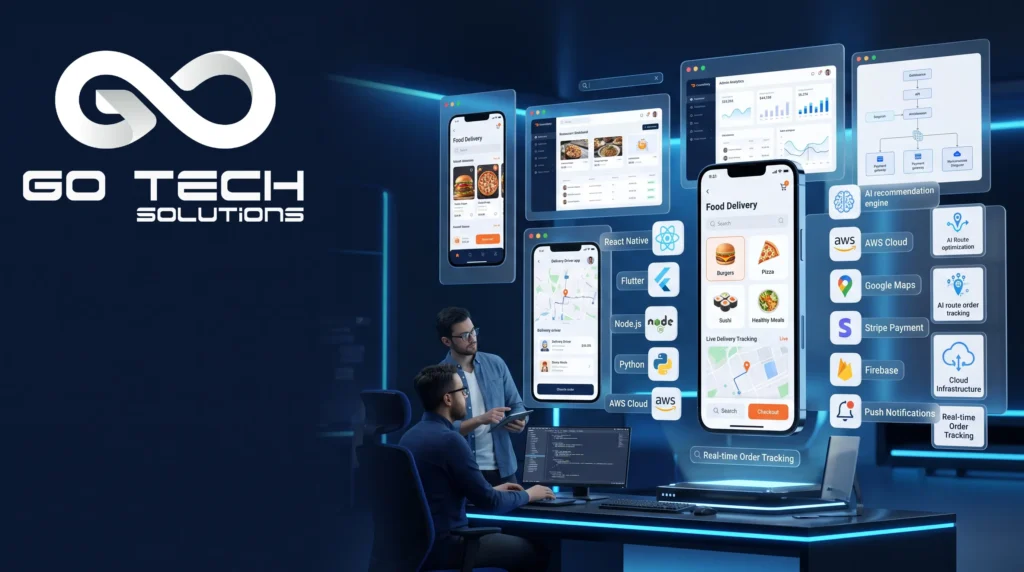
This guide walks through how to build a food delivery app end to end the three connected apps (customer, driver, restaurant), core features, the tech stack, and a realistic timeline and cost range whether you’re building a delivery marketplace or a single-restaurant ordering app.
A food delivery app is a multi-sided platform usually four connected apps (customer, driver, merchant, and an admin panel) that handles ordering, payment, driver dispatch, and real-time tracking. Building one in 2026 typically means shipping a focused MVP first, then scaling the parts that break under real order volume: dispatch, geolocation, and payments.
This guide is written for founders, restaurant groups, grocery operators, and logistics companies who are done reading “top 10 apps” listicles and want to understand what it actually takes to build and run one. We build these platforms for a living, so we’ve kept the marketing out of it and left the engineering in.
Key takeaways
- There are three delivery business models — aggregator, white-label (restaurant-to-consumer), and dark-store/delivery-as-a-service. The “most profitable” one depends entirely on who owns the customer and who owns the fleet.
- A real delivery platform is four apps, not one: customer, driver, merchant, and admin. Most first-time budgets forget the last two, which is where the cost hides.
- The features that decide whether you survive aren’t the flashy ones. They’re dispatch logic, live tracking, and payment splitting — the “boring” infrastructure.
- Cost is driven by feature depth and integrations, not by a magic number. A lean, launchable MVP is a very different project from a DoorDash clone, and anyone quoting you a flat figure before scoping is guessing.
- The market is large and still compounding — analysts size global online food delivery at roughly $355 billion in 2026, growing near 9% a year — but margins are thin, so unit economics have to be designed into the product, not bolted on later.
Quick answer: what does it take to build a delivery app?
To build a delivery app you need four things working together: a customer-facing app for browsing and ordering, a driver app for accepting and completing deliveries, a merchant interface for managing menus and orders, and an admin panel to run the whole operation. Underneath, you need a dispatch engine to assign orders, live GPS tracking, a payment system that can split money between you, the merchant, and the driver, and cloud infrastructure that scales during dinner rushes.
Most successful builds start with a narrow MVP one city, one category, one business model prove the unit economics, then invest in the harder engineering. Trying to launch a full multi-model super-app on day one is the most common way delivery startups run out of money before they run out of ideas.
The 2026 delivery market and why the window is still open
The demand isn’t in question. Depending on how analysts scope the category (meal-only versus meal-plus-grocery), the global online food delivery market is measured anywhere from roughly $285 billion to well over $1 trillion in 2026. Grand View Research puts the meal-focused market near $355 billion in 2026, on track for about $505 billion by 2030 at a ~9.4% compound annual growth rate. Mobile apps drive the overwhelming majority of orders Mordor Intelligence pegs mobile and tablet at roughly 83% of global delivery transactions.
Here’s the part most “market is huge, go build” articles skip: the aggregator layer is consolidated. In the US, DoorDash holds a majority share, with Uber Eats and Grubhub taking most of the rest. So if your plan is “another national three-sided food aggregator,” you’re not entering a market you’re declaring war on three companies with billions in capital and a decade of dispatch optimization.
That’s not a reason to stay out. It’s a reason to be specific. The genuinely open opportunities in 2026 are:
- Vertical and hyperlocal plays — a specific cuisine, a specific city, pharmacy, alcohol, B2B restaurant supply, ethnic-grocery, or catering.
- White-label ownership — restaurant groups and chains that want their own ordering app so they stop paying 15–30% commissions to aggregators.
- Operations-heavy niches — cold-chain, medical courier, same-day parts, where logistics discipline beats brand spend.
The retention data backs the vertical approach: industry reporting shows the large majority of delivery orders come from restaurants a customer has ordered from before, and most people stick with a single app. Loyalty, not novelty, is what compounds. A focused platform that owns a niche relationship can defend it. A generic clone cannot.
If your business already sits in one of these lanes courier and delivery services, grocery delivery, or logistics and warehousing you’re not starting from zero. You’re digitizing an operation you already understand, which is the strongest position to build from.
The three delivery business models (and which is most profitable)
Before a single line of code, decide who owns the customer and who owns the fleet. Everything else features, cost, margins flows from that answer.
1. Aggregator / platform-to-consumer
You connect many merchants with many customers and (usually) a pool of gig drivers. You own the customer and take a commission on every order. This is the DoorDash/Uber Eats model. Platform-to-consumer is the dominant structure Grand View Research attributes over 70% of market revenue to it because customers love choice and merchants love access without building their own tech.
Economics: high revenue potential, brutal costs. You pay for driver acquisition, customer acquisition, and support simultaneously. Margins are thin until scale. This is the most expensive model to build and the hardest to fund.
2. Restaurant-to-consumer / white-label
A single brand (or chain) runs its own ordering and delivery app. No commissions to a third party, full ownership of customer data, and delivery either in-house or via a delivery-as-a-service API. This is where a white-label restaurant app shines.
Economics: far lower customer-acquisition cost (you already have the customers), no aggregator commission bleed, and much higher lifetime value per customer. For an established restaurant group or grocery chain, this is frequently the most profitable path you’re not building a marketplace, you’re recapturing margin you’re currently paying away.
3. Dark-store / delivery-as-a-service
You own inventory in micro-fulfillment centers (“dark stores”) and promise speed the Gopuff / quick-commerce model or you sell fulfillment as an API to other businesses. Order picking is centralized, so drivers skip restaurant wait times.
Economics: capital-intensive (real estate, inventory) but predictable delivery times and strong margins on high-frequency categories. Delivery-as-a-service is a smart wedge for logistics operators who already have fleets.
So which is most profitable? For a restaurant or retailer that already has demand, white-label wins it converts existing customers at near-zero acquisition cost. For a well-capitalized operator chasing a fresh vertical, dark-store/quick-commerce offers the cleanest margins. The pure aggregator is the highest ceiling and the highest burn; it’s the wrong first project for almost everyone who isn’t venture-funded.
| Model | Owns customer | Owns fleet | Primary revenue | Build cost | Best for |
|---|---|---|---|---|---|
| Aggregator | Yes | Gig pool | Commission + fees | Highest | VC-backed marketplaces |
| White-label | Yes (existing) | In-house or DaaS | Direct sales, saved commission | Moderate | Restaurants, chains, grocers |
| Dark-store / DaaS | Sometimes | Yes | Product margin or fulfillment fees | High (ops) | Quick-commerce, logistics ops |
How delivery apps actually make money
If you only model “commission,” you’ll misprice your product. Mature platforms stack multiple revenue lines:
| Revenue stream | How it works | Notes |
|---|---|---|
| Merchant commission | 15–30% of order value on aggregators | The big one and the pain white-label buyers are escaping |
| Delivery / service fees | Charged to the customer per order | Sensitive to price elasticity; test carefully |
| Surge / dynamic pricing | Higher fees at peak demand | Requires real demand-prediction logic |
| Subscriptions | Free-delivery memberships (DashPass-style) | Drives frequency and retention |
| Advertising / promoted listings | Merchants pay for visibility | High-margin once you have order volume |
| Small-order & long-distance fees | Covers unprofitable edge cases | Protects contribution margin |
| White-label licensing / SaaS | You sell the platform to operators | Recurring revenue, no fleet risk |
The lesson: a delivery app’s profitability is a product design decision. Fees, subscriptions, and pricing logic have to be first-class features, not afterthoughts which is exactly why revenue modeling belongs in the product design phase, before build.
Anatomy of a delivery platform: the four connected apps
The single biggest budgeting mistake is thinking “an app.” You’re building an ecosystem.
The customer app
Browse, search, cart, checkout, pay, track. This is the part everyone imagines and the smallest slice of the real work. Core screens: discovery/search, menu/product, cart & checkout, payment, live order tracking, order history, ratings, support.
The driver app
Where deliveries actually happen. Availability toggle, order offers, accept/reject, turn-by-turn navigation, batched-order handling, proof of delivery, earnings dashboard, cash-out. If this app is clunky, drivers churn, and without drivers you have no service. Driver retention is a product problem before it’s an ops problem.
The merchant / restaurant app
Order acceptance, menu and inventory management, prep-time controls, availability, payout reports, promotions. Merchants who can’t easily manage orders will simply stop accepting them. This interface, often a tablet app plus a web dashboard, is quietly mission-critical.
The admin panel
The command center: dispatch oversight, live fleet map, dispute resolution, commission and payout configuration, analytics, fraud monitoring, zone and pricing management. This is usually a web application, and it’s where operators actually run the business day to day.
Four surfaces, one backend, one source of truth. Skip the merchant and admin layers in your estimate and you’ll underbudget by roughly half.
Must-have features: MVP vs. scale
You do not need everything on day one. You need the spine. Here’s the honest split.
MVP (launch this):
| App | MVP features |
|---|---|
| Customer | Registration, browse/search, cart, checkout, one payment method + cash on delivery, live tracking, order history, ratings |
| Driver | Onboarding, availability toggle, accept/reject, navigation, mark delivered, basic earnings |
| Merchant | Order notifications, accept/reject, menu edits, prep-time, daily payout summary |
| Admin | User/merchant management, manual + auto dispatch, live map, basic analytics, refunds |
Scale (earn the right to build these): Scheduled orders, order batching/stacking, subscriptions, loyalty and referrals, promo engine, surge pricing, in-app chat, multiple payment methods and wallets, multi-language/multi-currency, advanced fraud detection, AI ETA prediction, demand forecasting, and BI dashboards.
A disciplined MVP is the difference between learning cheaply and failing expensively. Every “scale” feature you defer is money you keep to fix what real users actually complain about. Scoping that line precisely is what a proper MVP and product-design engagement is for.
The tech stack that survives real traffic
There’s no single “correct” stack, but there are correct properties: real-time capability, geospatial performance, and the ability to scale horizontally when order volume spikes at 7pm. Here’s a stack we’d actually defend for a modern delivery build:
| Layer | Typical choice | Why |
|---|---|---|
| Mobile (customer & driver) | React Native or Flutter | One codebase, native performance, faster iteration than fully native for most cases |
| Web (merchant & admin) | React / Next.js + TypeScript | Fast, maintainable dashboards with real-time data |
| Backend | Node.js/Express or Django | Event-driven, strong real-time and API ecosystems |
| Real-time | WebSockets (order status, driver location) | Live tracking and dispatch need push, not polling |
| Database | PostgreSQL + PostGIS | Relational integrity plus first-class geospatial queries |
| Caching / queues | Redis, message queues | Handle bursts, decouple dispatch from ordering |
| Maps | Google Maps Platform or Mapbox | Geocoding, routing, distance matrix, ETAs |
| Payments | Stripe / Stripe Connect | Split payouts between platform, merchant, and driver |
| Notifications | Firebase Cloud Messaging, APNs, Twilio | Order and driver events across push and SMS |
| Cloud / DevOps | AWS, Azure, or GCP + containers + CI/CD | Autoscaling for peak load, reliable deploys |
Native iOS (Swift) and Android (Kotlin) still make sense when you need the absolute best mapping and background-location performance a legitimate concern for the driver app specifically. That’s a scoping decision, not a religious one. This is exactly the kind of tradeoff worth pressure-testing in a technical consultancy session before you commit a budget to it.
The stack above isn’t hypothetical it’s close to what we’ve shipped on real products, from a Flutter + Node.js + PostgreSQL + Stripe on-demand resident–provider app to a React + Next.js + PostgreSQL + AWS warehouse management platform built to handle multi-vendor logistics at scale.
The hard parts: dispatch, real-time tracking, and surge
This is the section the driver-pay listicles never write, and it’s the section that decides whether your app works.
Order dispatch. When an order comes in, which driver gets it? Naive “nearest driver” logic falls apart fast. A real dispatch engine weighs distance, driver direction, current load, restaurant prep time, order value, and fairness across drivers and reassigns automatically when someone declines. Getting this wrong means slow deliveries, cold food, and churned drivers. Getting it right is a genuine engineering and data problem, often the single most valuable piece of IP in the whole platform.
Real-time location & ETAs. Live driver tracking looks simple and isn’t. You’re streaming GPS from thousands of devices, updating maps without draining phone batteries, recalculating ETAs against live traffic, and keeping customer, merchant, and admin views in sync all over WebSockets, all at once. Background location on iOS and Android each have their own constraints that will bite an inexperienced team.
Surge & demand prediction. Dynamic pricing and driver incentives depend on forecasting demand by zone and time. That’s a data pipeline and a modeling problem, not a checkbox. It’s a “phase two” capability for most builds, but the data model has to be designed for it from the start.
None of this is a reason to be intimidated. It’s a reason to not treat a delivery app like a to-do list app. These systems reward experience, and they punish “we’ll figure it out later.
Where AI actually earns its place in a 2026 delivery app
“AI-powered” is on every pitch deck, so let’s separate the parts that move real numbers from the parts that are decoration. In a delivery platform, AI and machine learning pay off in a handful of concrete places:
- ETA prediction. The gap between a promised delivery time and the real one is the single biggest driver of customer trust. Models trained on historical order, traffic, and prep-time data beat static estimates and reduce “where’s my order” support tickets.
- Demand forecasting. Predicting order volume by zone and time lets you position drivers before the rush instead of scrambling during it. This directly improves driver utilization one of the KPIs that decides whether you’re profitable.
- Dynamic pricing and incentives. Surge fees and driver bonuses should respond to predicted supply/demand imbalance, not a human guessing.
- Route and batch optimization. Deciding which orders to stack and in what sequence is a live optimization problem that ML handles better than rules alone, lifting deliveries-per-hour.
- Fraud detection. Fake accounts, promo abuse, and payment fraud scale with your growth. Anomaly-detection models catch patterns rules miss.
- Support automation. An AI assistant that handles order-status and refund questions deflects a large share of tickets a real cost line at volume.
The honest caveat: none of this belongs in your MVP. AI features need data, and you don’t have data until you’re running orders. Design the data model to capture the right events from day one, ship the rules-based version first, and layer intelligence in once you have signal. Teams that lead with AI and no data are building on sand. Automating the operational plumbing around these systems payouts, reconciliation, notifications, reporting is often the faster ROI, and it’s squarely what business process automation is for.
Payments, security, and compliance you can’t skip
This is the least glamorous section and the one most likely to sink you if you get it wrong. You’re moving money between three parties and handling personal data at scale.
Split payments. In an aggregator or marketplace, each order’s money has to divide between the platform, the merchant, and the driver often with different payout schedules. Doing this by hand is a nightmare; a payments layer built on something like Stripe Connect handles the splits, payouts, and reporting. Cash on delivery still matters in many markets and adds its own reconciliation logic.
PCI DSS. If you touch card data, you’re on the hook for PCI DSS compliance. The practical answer for most builds is to never let raw card data hit your servers tokenize through your payment provider which shrinks your compliance scope dramatically. That’s an architecture decision, made early.
Data privacy. You’re collecting names, addresses, locations, and order history. Depending on your markets, GDPR, CCPA, and local privacy rules apply. Consent, data retention, deletion, and secure storage aren’t optional features they’re legal obligations with real penalties.
Driver trust and safety. Background checks, identity verification, and in-app safety features (share-trip, emergency contact) protect customers and your brand. Skimping here is a headline waiting to happen.
Platform-store compliance. Apple’s App Store and Google Play have their own review rules for delivery, payments, and location use. Non-compliance means rejection and lost launch time. Building to those guidelines from the start avoids painful late rewrites.
Security fundamentals. Encryption in transit and at rest, role-based access control on the admin panel, rate limiting, and audit logging aren’t nice-to-haves in a system that moves money and tracks people’s locations. This is exactly the kind of hardening that belongs in a technical consultancy review before launch, not after an incident.
Get these right and they’re invisible. Get them wrong and they become the only thing anyone remembers about your product.
What it actually costs to build
Any article that opens with “a delivery app costs $X” is selling you a number, not scoping a project. Cost is a function of model, number of apps, feature depth, integrations, and platform count. Here’s an honest framework instead of a fake figure.
The cost drivers, ranked:
- Model — an aggregator (four apps, dispatch, split payments) costs multiples of a single white-label ordering app.
- Number of surfaces — customer + driver + merchant + admin, each on iOS and Android and web, multiplies scope.
- Feature depth — cash-on-delivery and one payment method is cheap; surge pricing, batching, subscriptions, and AI ETAs are not.
- Integrations — payments, maps, SMS, POS systems, accounting, and third-party logistics each add real work.
- Design & compliance — polished UX, accessibility, and PCI/data-privacy requirements are line items, not freebies.
Rough shape (not a quote): a focused white-label MVP is the lightest project; a multi-app on-demand MVP with dispatch, live tracking, and split payments is a mid-weight project; a full aggregator platform at scale is a long-term program with ongoing engineering. The right way to get a real number is to scope features against a fixed model which is exactly what our project cost calculator and a scoping call are built to do.
One thing we’ll always tell you straight: we bill against milestones tied to deliverables, so you pay for shipped software, not for promises. A vague “it’ll be around $X” from anyone before scoping should make you more nervous, not less.
A realistic build timeline
| Phase | What happens | Typical duration |
|---|---|---|
| Discovery & product design | Model, scope, wireframes, architecture, data model | 2–4 weeks |
| MVP build | Core customer + driver + merchant + admin, one city | 3–5 months |
| Beta & hardening | Real drivers, real orders, fix what breaks | 3–6 weeks |
| Launch (v1) | Public in one market | — |
| Scale phase | Batching, surge, subscriptions, new zones/cities | Ongoing |
For most operators, a functioning MVP is a 3–6 month effort, not a two-week weekend project and not a two-year moonshot. Anyone promising either extreme is mis-scoping. (For context, our published MVP timelines run 3–6 months for mobile products that’s the honest range.)
What founders should copy from DoorDash, Uber Eats & Instacart and what to avoid
The point of studying the incumbents isn’t to clone them. It’s to steal the lessons and skip the scars.
- DoorDash — its edge is logistics density and driver supply, plus subscriptions (DashPass) that drive repeat orders.
Copy: obsess over dispatch efficiency and retention mechanics.
Avoid: thinking you can win nationally on brand they already have density you can’t buy. - Uber Eats — shares a rider network and toggling between rides and food.
Copy: the idea of shared infrastructure and surge economics.
Avoid: surge as a blunt instrument that alienates customers; tune it carefully. - Instacart — the “shopper picks then delivers” model, with batch orders.
Copy: batching to lift per-hour efficiency, and higher-AOV verticals like grocery.
Avoid: underestimating the complexity of item substitutions and real-time inventory. - Gopuff — owns inventory in dark stores for speed.
Copy: vertical integration for predictable ETAs.
Avoid: the capital burden unless your volume justifies the real estate.
The through-line: incumbents win on operations and retention, not on features. A prettier UI won’t beat them. A tighter niche with better unit economics can.
The unit economics investors (and you) will ask about
If you take money or even if you don’t these are the numbers that decide whether you have a business or an expensive hobby. Design the product to move them.
| Metric | What it tells you | Why it matters |
|---|---|---|
| Average order value (AOV) | Revenue per order | Higher AOV makes delivery economics work |
| Contribution margin per order | Profit after direct delivery costs | If this is negative at scale, growth kills you |
| Customer acquisition cost (CAC) | Cost to win a customer | White-label wins here you already have them |
| Retention / repeat rate | Orders from returning customers | The single biggest driver of long-term profit |
| Driver utilization | Deliveries per driver-hour | Batching and dispatch quality live here |
| Take rate | Your cut of each order | Balances merchant supply vs. your revenue |
Most delivery startups die not from lack of demand but from negative contribution margin at scale every order loses money and growth accelerates the losses. Building the analytics to see this early is not optional; it’s survival. That reporting layer is a core part of the admin/web platform, and automating the operational glue around it is where business process automation pays for itself.
Five mistakes that kill delivery startups
- Building all four apps at full fidelity before validating one city. Prove the model small, then scale.
- Ignoring the driver experience. No drivers, no service. The driver app is not the “secondary” app.
- Treating dispatch as an afterthought. It’s your core IP. Cheap dispatch = slow deliveries = churn.
- Pricing without modeling contribution margin. Growth on negative margins is a countdown timer.
- Choosing a stack that can’t scale for peak load. Dinner-rush traffic is not average traffic architect for the spike.
Every one of these is avoidable with the right scope and the right team. None of them are avoidable by picking a trendier framework.
Build, buy, or white-label? A decision framework
You have three paths. Pick honestly based on where you are.
- Buy a SaaS platform if you need to be live next month, your requirements are standard, and you can accept someone else’s roadmap and per-order fees. Fastest, cheapest upfront, least control, no IP.
- White-label / customize if you have an established brand and customers, want your own app and data, and need to escape aggregator commissions without building from scratch. Best ROI for most restaurants and grocers.
- Custom build if your model, operations, or scale are genuinely differentiated, you need to own the IP, and you’re building a venture, not a feature. Most control, highest ceiling, biggest commitment.
| If you are… | Best path |
|---|---|
| A restaurant/chain escaping commissions | White-label |
| A retailer testing a new delivery vertical | White-label or lean custom MVP |
| A logistics operator with a fleet | Custom (DaaS) build |
| A funded startup chasing a new marketplace | Custom build |
| A team needing to launch in weeks | Buy SaaS, migrate later |
Not sure which bucket you’re in? That’s the entire point of a scoping conversation it’s usually clearer in 30 minutes than in 30 hours of research.
How Go Tech builds delivery platforms
We’re a Houston-based software development company with 40+ senior engineers, and we’ve shipped the exact building blocks a delivery platform needs: on-demand apps with real-time tracking and Stripe payments, multi-vendor marketplaces, and logistics/warehouse systems built to scale. We work engineers-first you talk to the people building your product and we bill against milestones, so you pay for delivered software.
If you’re weighing a delivery build, the useful next step isn’t more reading. It’s a scoped conversation about your model, your MVP, and an honest estimate in writing.
Book a free 30-minute strategy call → · Estimate your build with our cost calculator →
FAQ
How much does it cost to build a food delivery app?
There’s no honest flat number, because cost depends on the business model, how many of the four apps you build (customer, driver, merchant, admin), feature depth, and integrations. A focused white-label ordering app is the lightest project; a multi-app on-demand platform with dispatch, live tracking, and split payments is mid-weight; a full aggregator at scale is an ongoing program. Scope the features against a fixed model to get a real figure.
How long does it take to build a delivery app?
A functional MVP for one market typically takes 3–6 months: 2–4 weeks of discovery and design, then 3–5 months of build, plus a few weeks of beta hardening. Full aggregator platforms are longer, ongoing programs.
Which delivery business model is most profitable?
For a business that already has customers (a restaurant chain or grocer), the white-label model is usually most profitable because it eliminates 15–30% aggregator commissions and has near-zero customer-acquisition cost. Dark-store/quick-commerce offers strong margins for well-capitalized operators. The pure aggregator has the highest ceiling but the highest burn.
How do food delivery apps make money?
Through stacked revenue: merchant commissions (15–30%), customer delivery/service fees, surge pricing, subscriptions, promoted listings/advertising, small-order fees, and white-label licensing. Profitability is a product-design decision, not a single lever.
What features does a food delivery app need?
At MVP: registration, browse/search, cart and checkout, at least one payment method plus cash on delivery, live order tracking, a driver app with dispatch and navigation, a merchant order interface, and an admin panel. Batching, surge, subscriptions, loyalty, and AI ETAs come later.
Should I build a native or cross-platform delivery app?
Cross-platform (React Native or Flutter) is efficient for the customer and merchant apps. The driver app sometimes benefits from native (Swift/Kotlin) for best background-location and mapping performance. It’s a scoping decision based on your priorities and budget.
What tech stack is best for a delivery app?
Commonly React Native/Flutter for mobile, React/Next.js for web dashboards, Node.js or Django on the backend, PostgreSQL with PostGIS for geospatial data, Redis and WebSockets for real-time, Google Maps or Mapbox for routing, Stripe Connect for split payments, and AWS/Azure/GCP for autoscaling infrastructure.
Can I build a white-label delivery app to compete with DoorDash?
You won’t out-scale DoorDash nationally, but you don’t need to. A white-label app lets an established brand own its customers and margins in its own market. The winning strategy is a defensible niche or existing customer base, not a generic clone.
How do delivery apps handle driver dispatch and tracking?
A dispatch engine assigns orders by weighing distance, driver direction, current load, and prep time, reassigning automatically on declines. Live tracking streams GPS over WebSockets and recalculates ETAs against traffic while keeping customer, merchant, and admin views in sync.
Do I need all four apps to launch?
Functionally, yes but at MVP fidelity, not full fidelity. You need a customer app, a driver app, a merchant interface, and an admin panel to run even a small operation. What you defer is feature depth, not entire surfaces.